Dune Seas
Migrating sand buries roads, reveals towers, and exposes bones that do not belong to anything native to Aetharia.
Beyond Aetharia’s Protection
A vast scar of desert, buried cities, and wounded reality surrounds northern Aetharia. Here, the rejected built new civilizations among the ruins, while things from beyond the world continue to find their way through.
The Truth Beyond the Border
The Forsaken Lands are not where civilization ended. They are where rejected people built new civilizations among the ruins of old ones.
The Forsaken are not one people by blood, species, culture, or allegiance. The name includes those banished by Aetharia, those who fled it, and generations born beyond its protection.
Some were condemned for terrible crimes. Others were expelled for political resistance, forbidden magic, debt, prohibited beliefs, undesirable ancestry, or the simple inconvenience of being difficult to control.
Aetharia calls the region lawless while relying upon its settlements to absorb the first impact of every rift, every Other, and every new disaster moving toward its protected heartlands.
Known Territory
Roads vanish beneath migrating sand, rifts alter familiar terrain, and storms uncover cities that were buried before Aetharia had a name.
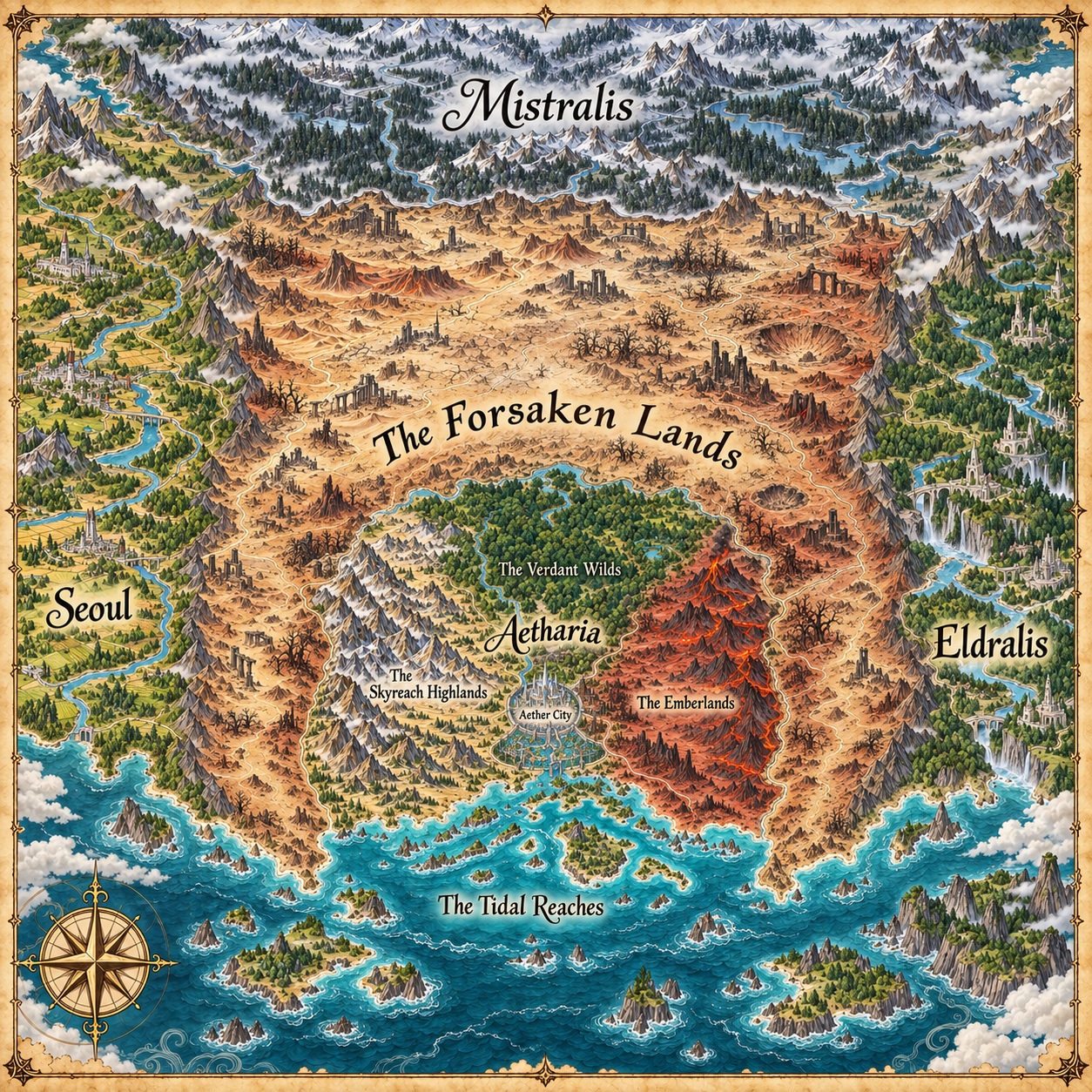
Choose a Path
Every road leads deeper into the Lands. None promise to bring travelers back unchanged.
Learn how the Forsaken survive, govern, trade, practice magic, and endure Aetharia’s hypocrisy.
The apocalypse did not end. It simply learned to open again.
Predators, guardians, imitators, disasters, and thinking beings from beyond Aetharia.
A fortified settlement built inside the remains of the old world, defended by people Aetharia discarded.
Settlements, hidden enclaves, ruins, roads, markets, and strongholds scattered throughout the wastes.
Five rulers, five specialized systems of control, and one hidden network binding their territories together.
Survivors, leaders, scavengers, protectors, exiles, and beings whose loyalties remain unknown.
Selected Field Records
Threat class measures the force normally required to survive an encounter. It does not measure morality.
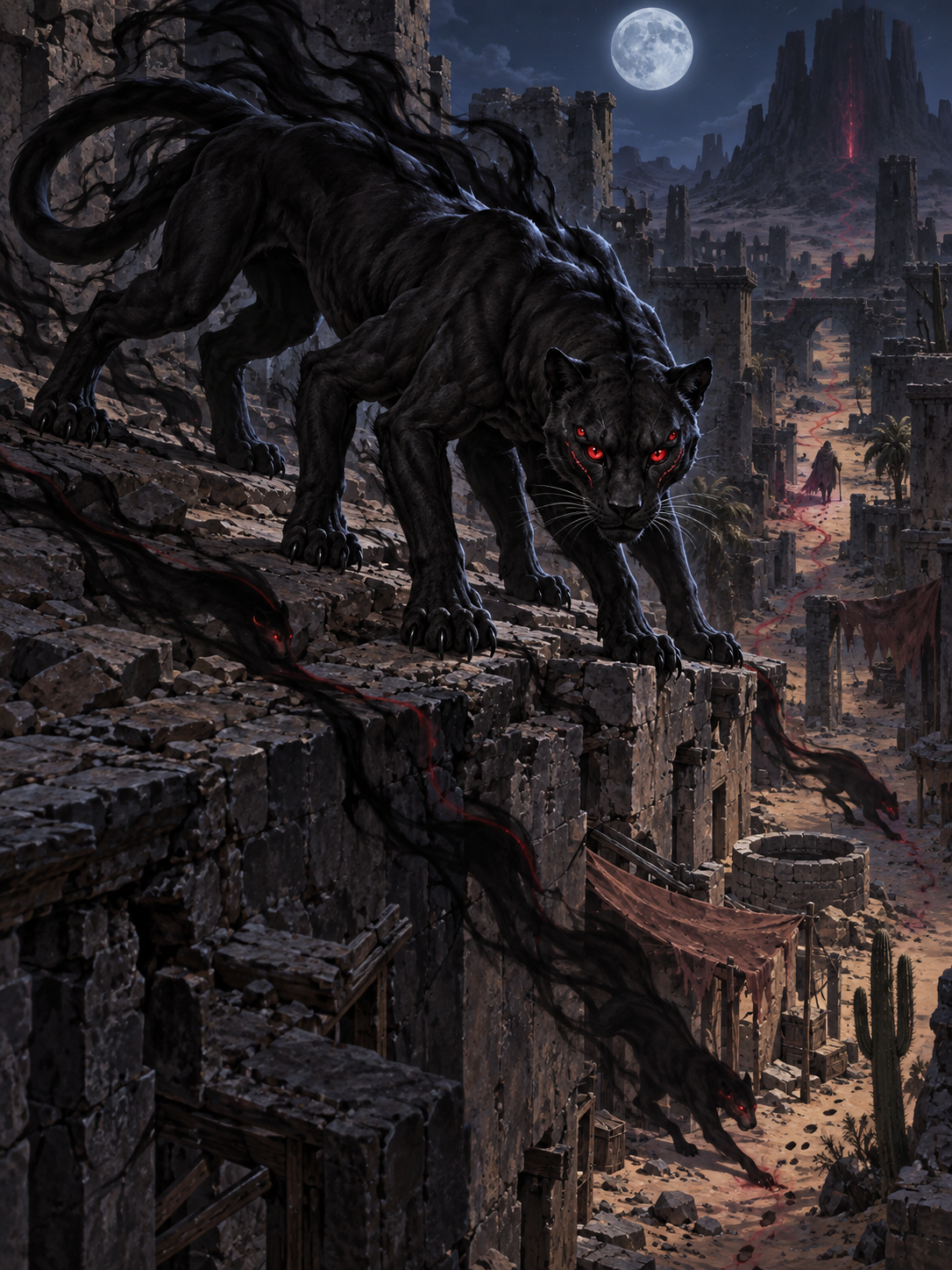
Once one tastes blood, it tracks the biological identity of its prey. Distance, disguise, shapeshifting, and concealment do not reliably break the hunt.
Open the Field Record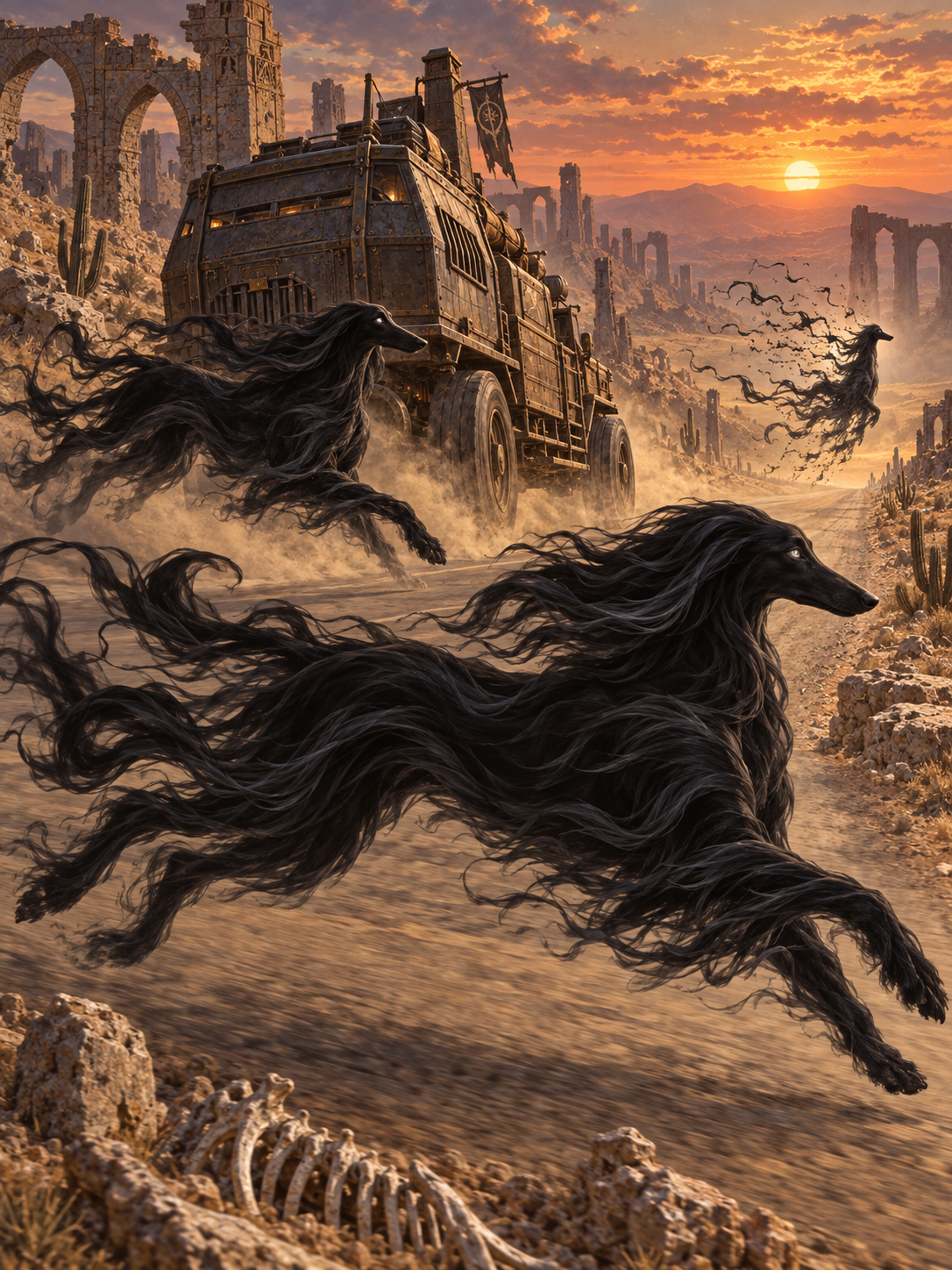
Harmless shadow-creatures that race moving transports, leave no tracks, and vanish when the journey stops. Frightening does not always mean hostile.
Open the Field RecordA Settlement That Endures
Founded by Axel Hawke and protected by the Hollow Fangs, the Hollowed Grounds survives through guarded water, buried agriculture, trade, practical law, and the combined labor of people who refuse to be disposable.
Aetharia calls this place empty. The ruins know better.
Forsaken Sanctuary
One of the largest independent settlements in the Forsaken Lands, built through the collapsed streets, hollow foundations, exposed tunnels, and buried waterworks of a city destroyed by an old rift.
Settlement Overview
The population remains near eight hundred but changes constantly as refugees, caravans, scouts, traders, and travelers arrive or disappear into the desert.
The original city collapsed into a subterranean complex. Generations of Forsaken reinforced its sunken courtyards, hollow foundations, and exposed tunnels as cisterns, storehouses, workshops, shelters, and escape routes.
Colossal bones exposed by the collapse now serve as barricades and structural supports. No one agrees whether the skeleton belonged to an Other or a native creature killed during the city’s fall.
No one is surrendered to the place that cast them out.
The settlement does not automatically honor extradition demands, sell people to settle debts, return refugees to the Bloodthorns, or treat birth as evidence of guilt. Accusations are judged locally.
Settlement Layout
The settlement occupies multiple levels of collapsed streets, buried chambers, reinforced ruins, and defensive structures built around the old city’s remains.
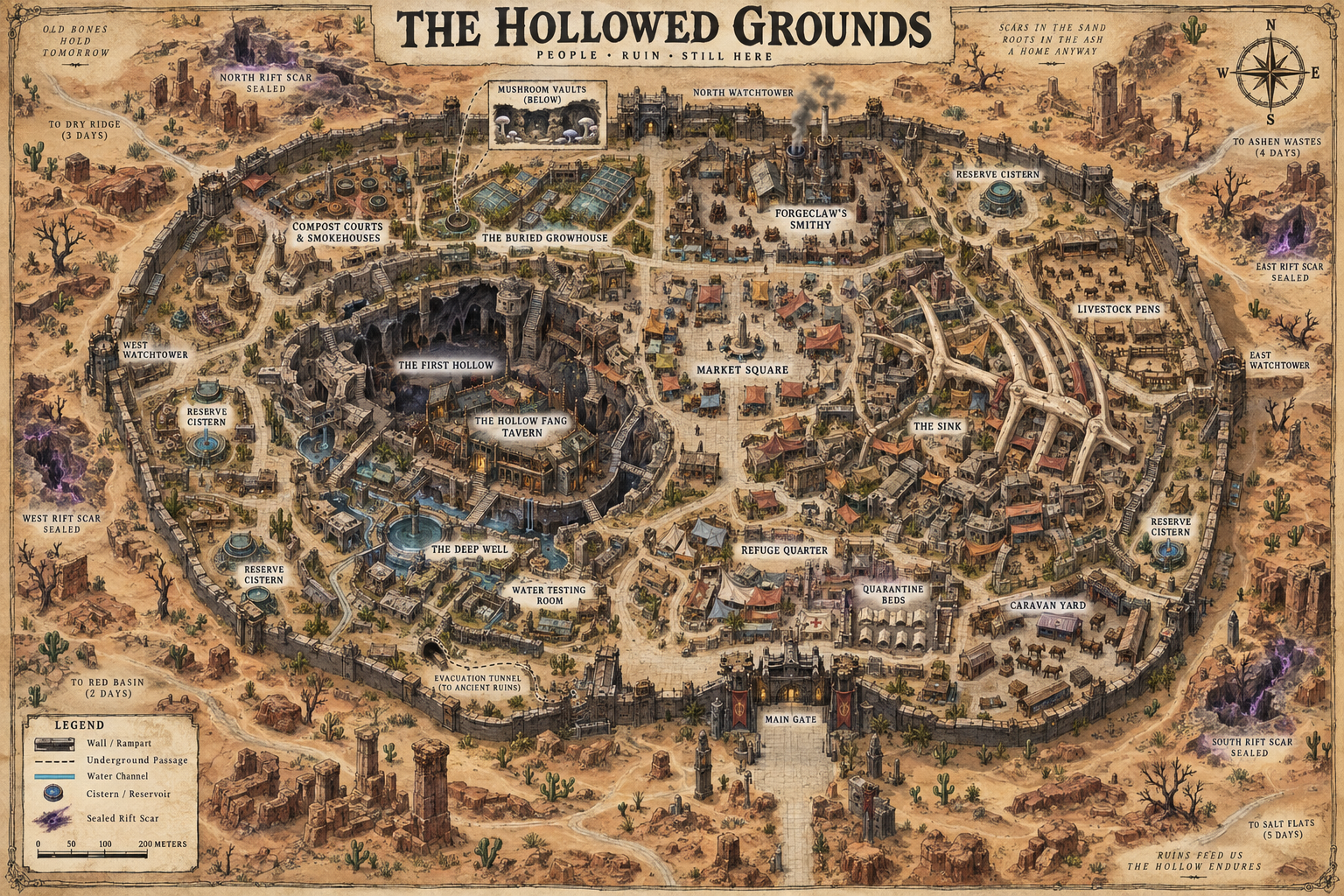
The oldest and strongest district surrounds the Hollow Fang Tavern.
During major attacks, residents retreat into its protected chambers, cisterns, treatment rooms, and evacuation tunnels.
The outer defense follows surviving foundations and combines ruined masonry, salvaged metal, timber, bone, and collapsed structures.
Watchtowers monitor likely approaches while narrow passages funnel attackers into exposed ground.
A dense residential district occupying several collapsed streets.
Housing, repair yards, communal ovens, and covered gathering spaces crowd together beneath colossal bone supports and salvaged awnings.
New arrivals receive water, food, shade, medical attention, and temporary shelter near a guarded entrance.
Immediate safety is not something newcomers must earn. Long-term residents contribute according to their abilities. Disability, illness, age, and caregiving are recognized rather than treated as failures.
Temporary stalls occupy a broad stretch of ancient paving and can be packed quickly during an attack or rift warning.
Selling people, cursed bindings, or information intended to facilitate kidnapping is forbidden.
Garran Forgeclaw produces weapons, braces, pumps, tools, ammunition, repairs, and expedition equipment.
He studies specific Others rather than pretending one element or weapon can kill them all.
A sprawling communal stronghold built from an ancient stone structure and generations of added rooms, walls, stairs, platforms, and reinforcements.
It serves as tavern, dining hall, meeting place, shelter, caravan registry, message exchange, informal court, and crisis headquarters.
Government and Defense
Axel Hawke is the settlement’s central leader. The Hollow Fangs oversee defense, scouting, rescue, rift response, caravan protection, and investigations into Bloodthorn activity.
Their reputation and field experience make them essential to the sanctuary’s survival.
Permanent decisions involving water, exile, punishment, and trade restrictions require agreement from established community representatives.
The armed protectors do not possess unlimited civil authority.
Survival Systems
The settlement’s strength is not abundance. It is overlap, redundancy, local knowledge, and infrastructure its own people can repair.
The old city’s underground channels, settling chambers, and cisterns were partially restored across generations. The Deep Well descends through the First Hollow into guarded waterworks.
Water is tested daily and after every tremor, magical storm, unexplained illness, or report of an Other near the channels. Questionable channels are sealed without debate. Rift-tainted water is never diluted into the general supply.
No single crop feeds the settlement. Cactus, beans, grain, and squash form the dependable core, while mesquite flour stretches grain stores and gives local flatbread its dark, slightly sweet flavor.
The buried growhouse protects medicinal herbs, delicate vegetables, seedlings, seed stock, spices, mushrooms, and indicator plants used in water testing. It cannot feed everyone. It preserves what would be hardest to replace.
Waterkeepers, growers, scavengers, hunters, sanitation crews, guards, healers, animal handlers, and traders depend on one another.
Stored water supports the growhouse. Plant waste supports mushrooms and compost. Livestock provides milk and manure. Scavengers recover repair material. Trade fills whatever the land cannot.
The Hollowed Grounds is stable, not safe. Response plans prioritize survival need rather than wealth or rank.
The Settlement Is Stable, Not Safe
Contamination near the aquifer can threaten the entire settlement.
A broken roof can destroy fragile crops and irreplaceable seedlings.
Illness can damage food, labor, transport, and trade simultaneously.
Essential supplies disappear quickly when the stable route closes.
Redundant systems buy time, but every replacement still needs labor.
A delayed caravan during a water scare can become catastrophic.
Associated Characters
Nothing vital is trusted to a single machine, a single mage, a single caravan, or a single leader. Everything essential can be repaired by its own people.
Regional Place Index
Five Bloodthorn holdings dominate the current record. Each was built around one Thornlord’s expertise, one specialized form of control, and one stolen gateway into a network older than their organization.


Five Methods of Control
These are not five copies of the same fortress. Each place exists to make one kind of cruelty efficient.
The holdings form a specialized network. Their architecture, industries, defenses, and internal systems reflect the authority of the Thornlord controlling them.
Their proper place names remain intentionally undecided. Until those names are chosen, the records identify each holding through its ruler and function.
Every map below is a separate documented location.
Mapped Holdings
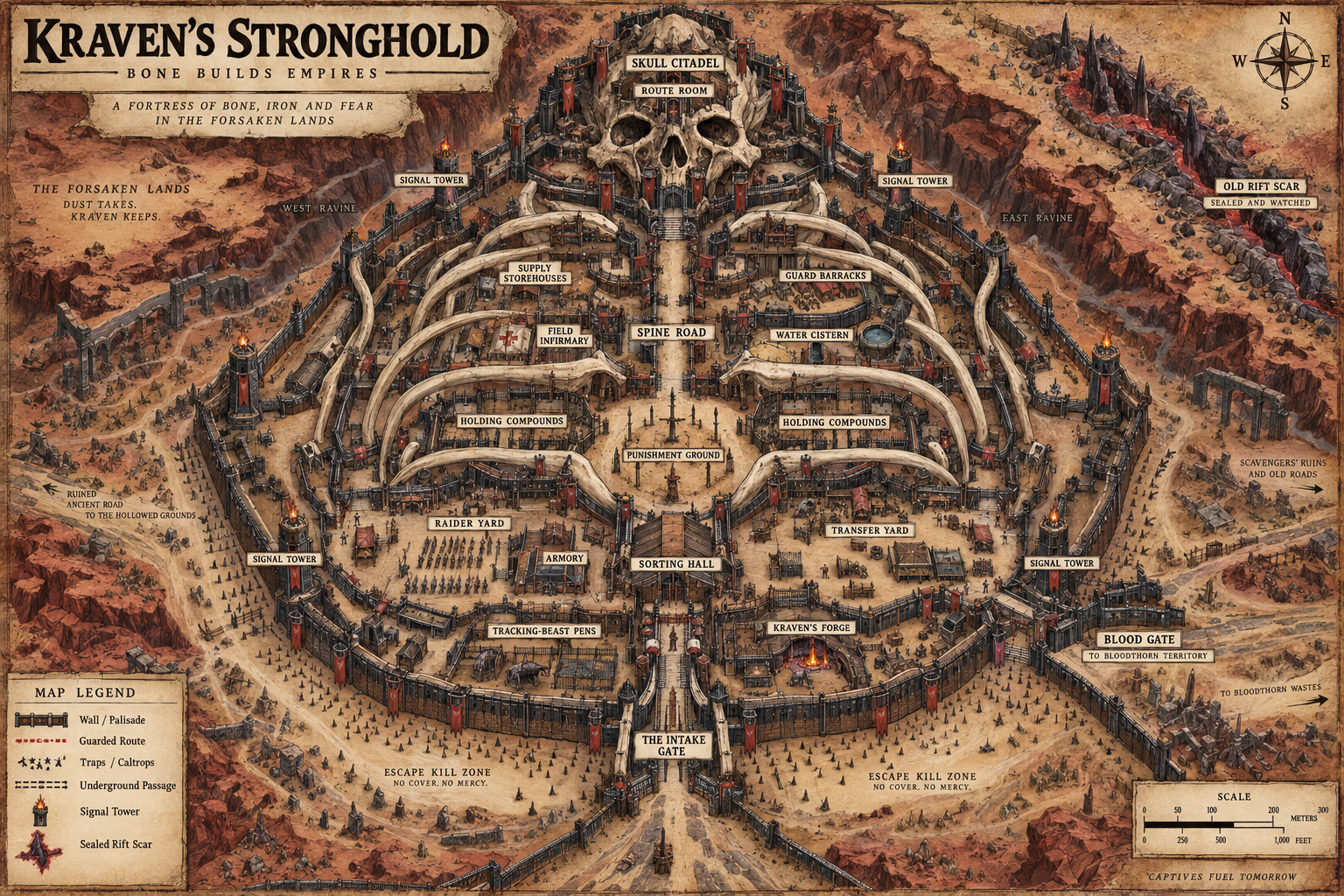
A brutal intake fortress built through the exposed skeleton of a dead Other. Rib bones form barricades, watch platforms climb the spine, and the skull serves as the command structure.
Intake, capture, punishment, armed deployment, and transfer.
Raider yards, armory, tracking-beast enclosures, temporary holding areas, punishment ground, route archive, and transfer yard.
The Skull Gate lies inside the dead Other’s hollow cranial chamber, framed by its jaws and reinforced with iron.
The surrounding bones vibrate whenever another known gate activates. It is the oldest and strongest Bloodthorn anchor.
A prosperous desert trade city built around an ancient crossroads and one of the region’s richest water sources. Commerce gives the operation legitimacy and camouflage.
Trade, finance, auctions, laundering, political protection, and disguised trafficking.
Caravan yards, warehouses, shaded canals, private suites, auction chambers, encoded archives, and disguised exits.
The Drowned Gate is concealed beneath the Living Spring and reached through smugglers’ docks.
It manifests as a perfectly still wall of black water. Travelers emerge wet even though no water crosses with them.
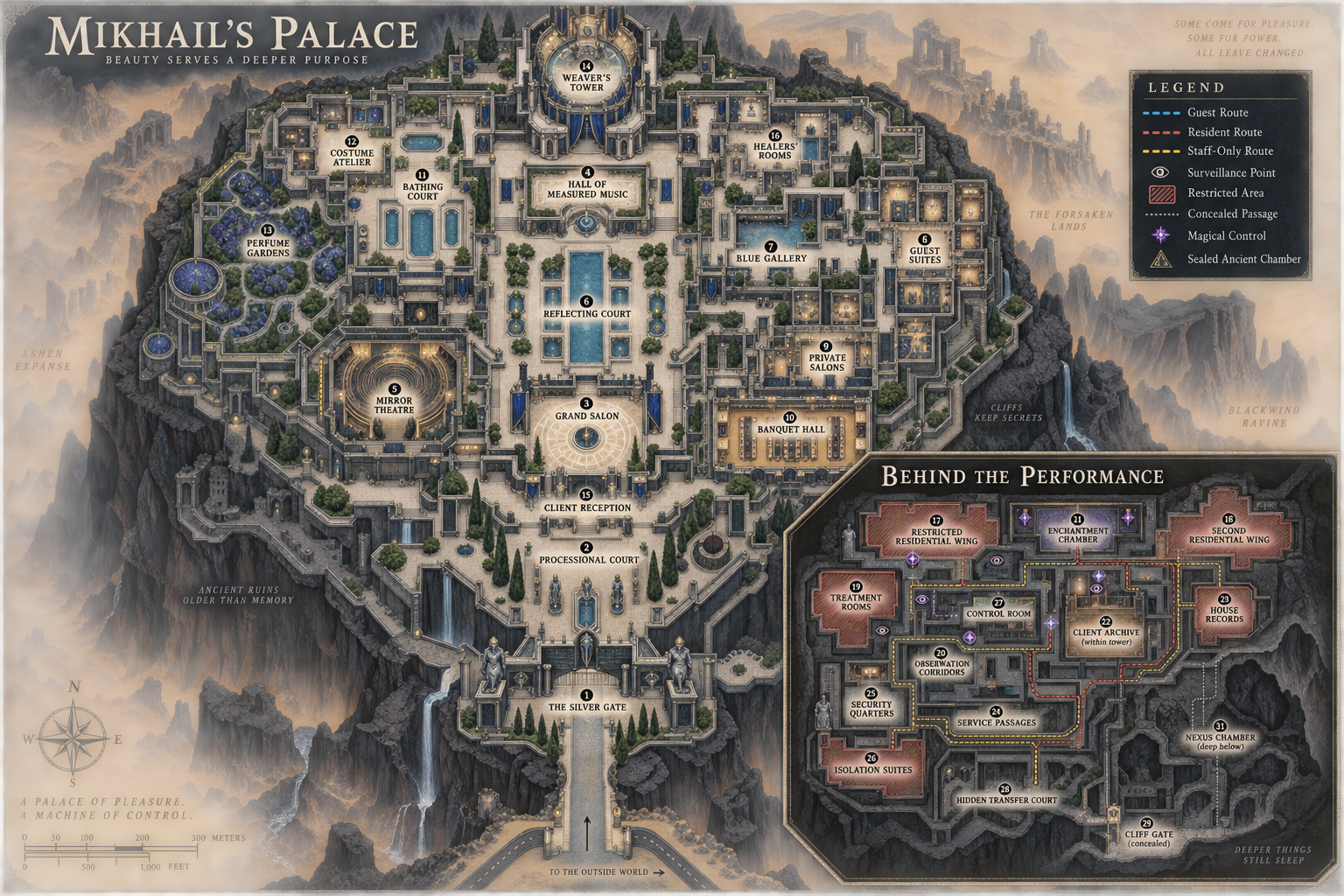
A monumental pleasure palace carved into black stone and older ruins. Silver chains, dark blue fabric, reflecting pools, measured music, and staged performances create controlled beauty.
Dependency, manufactured consent, compromised clients, surveillance, and social leverage.
Public salons, performance halls, private suites, restricted wings, costume rooms, treatment rooms, and hidden archives.
The Mirror Gate occupies a black-stone chamber beneath the palace beside a shallow silver pool.
During activation, the gate’s reflection opens before the physical doorway does.
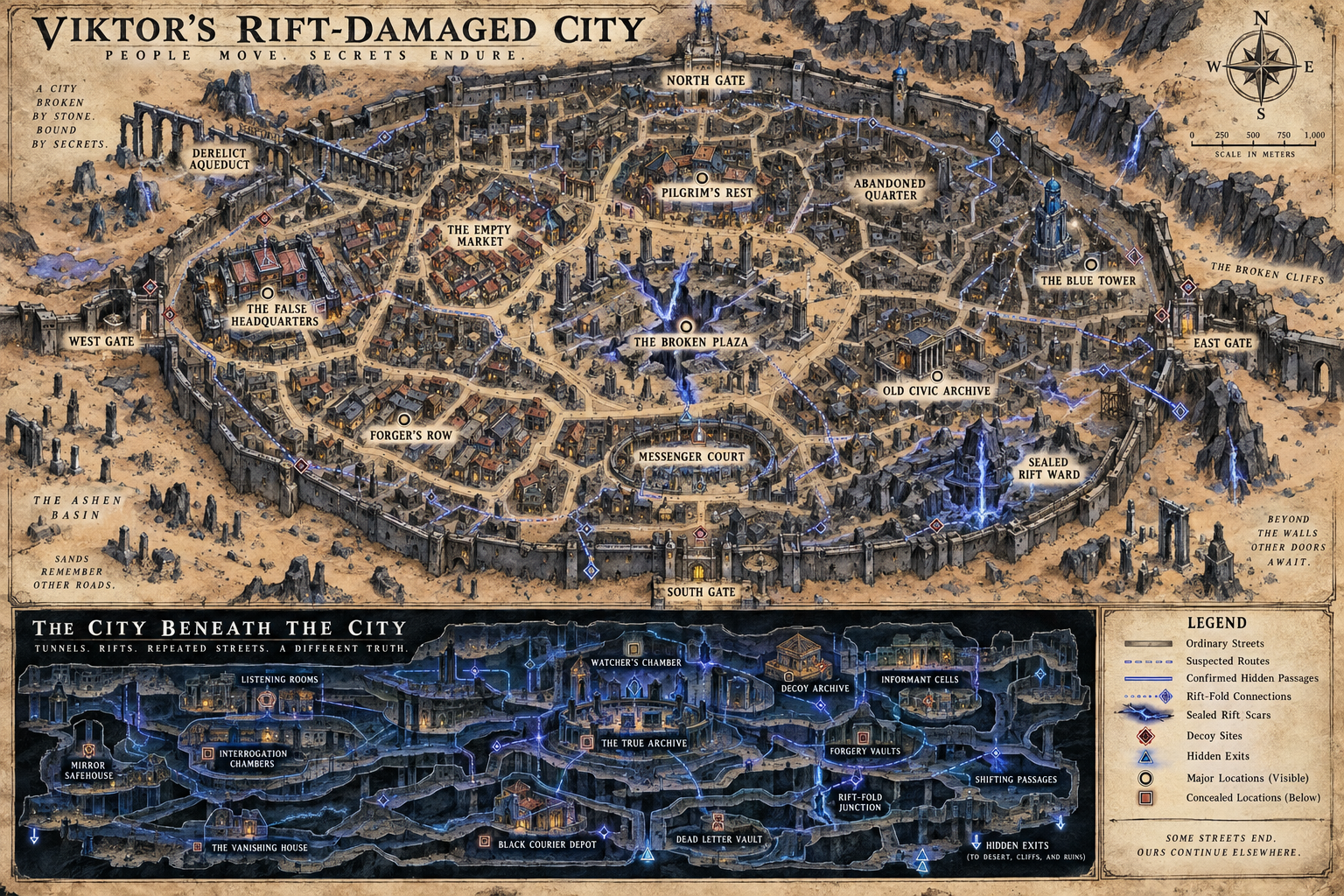
An apparent headquarters inside a half-abandoned city damaged by an old rift. Streets overlap, tunnels connect unrelated buildings, and rooms do not remain reachable by the same route.
Surveillance, infiltration, forgery, intelligence, target acquisition, and uncertainty.
False safehouses, decoy offices, listening rooms, messenger passages, interrogation rooms, and an archive mapping people.
The Fold Gate is the Rift-Fold Junction beneath the city. It has no permanent doorway.
Several incompatible corridors must be aligned until one opens into the selected stronghold.
A severe compound resembling a monastery, academy, and correctional institution. It is spotless, symmetrical, scheduled, and quiet.
Long-term captivity, conditioning, administration, discipline, identity erasure, and transfer.
Residential wards, instruction rooms, controlled courtyards, infirmary, isolation chambers, archives, and observation tower.
The Sealed Gate lies beneath the Records Vault and connects to the enclosed Transfer Court.
Locks, ledgers, authorization stations, and observation posts surround it. Every approved crossing is documented.
Network Flow
Intelligence, surveillance, infiltration, and target selection.
Capture, armed force, pursuit, punishment, and transfer.
Records, schedules, dependency, conditioning, and compliance.
Manufactured consent, compromised clients, and social leverage.
Money, markets, political protection, and concealed ownership.
Hidden Transit Network
Each holding contains one ancient Nexus Gate capable of reaching the other four known anchors. Keys, sigils, and controlled alignments select the intended destination.
Crossings appear to last moments, but travelers experience a longer passage through a dark intermediary space. Some hear distant movement, see doors outside the known routes, or return with memories that do not belong to them.
A sixth destination appears during rare alignments. It has no known surface location, acknowledged key, or Bloodthorn stronghold. Its signal is stronger and more stable than any of the five known anchors.
Every person sent through appears to cross successfully. Nobody has returned.
The five holdings are not the complete network. They are surviving secondary stations in a system whose true owners still control the center.
Anything may enter the Sixth Thorn. Only its owners decide what leaves.
Regional Expansion
Future records will hold additional Forsaken settlements, caravan routes, wells, ruins, rift zones, burial grounds, landmarks, territories claimed by Others, and abandoned strongholds. No additional location names are locked yet.
Distributed Syndicate // Five Seats of Control
A trafficking network rooted through the Forsaken Lands and fed by respectable demand beyond them. Five Thornlords divide its essential functions, each ruling a different kind of captivity.
These records describe coercion, captivity, and exploitation
Syndicate Overview
The Bloodthorns are feared throughout the Lands, but they do not represent the Forsaken. They survive by exploiting fragmented authority and the people respectable society prefers not to protect.
Their power comes from trafficking, forced labor, extortion, blackmail, smuggling, and the sale of captives. Their victims include travelers, refugees, isolated Forsaken, border residents, and people selected for wealthy clients within Aetharia.
Individual operations control camps, routes, markets, informants, and captive labor sites. The five Thornlords coordinate the functions that allow those scattered operations to behave like one organism.
Operational Chain
The order changes according to the job. Any Thornlord may commission another branch, trade information, request punishment, or redirect a captive through the network.
The Shadow
Finds targets, vulnerabilities, routes, secrets, and the people willing to sell them.
The Butcher
Directs raids, armed enforcement, abduction, intake, sorting, and immediate terror.
The Matron
Turns captivity into routine through records, discipline, deprivation, and forced dependency.
The Weaver
Builds dependence, compromised witnesses, social pressure, and manufactured consent.
The Broker
Negotiates sales, transfers, payment, wealthy clients, and political protection.
Restricted Archive
Select a title to open its dossier. Each holding is designed around its ruler's specialty, and each contains an anchor into the Bloodthorn Nexus.
 Seat I // Force
The Butcher
Abduction // Raids // Armed Enforcement
Kraven looks like the Forsaken Lands have tried to kill him repeatedly and failed. His brutality is disciplined, experienced, and backed by strong logistics.
 Seat II // Need
The Broker
Negotiation // Distribution // Wealthy Clients
Tristan makes exploitation sound like opportunity and an atrocity sound like a mutually beneficial arrangement.
 Seat III // Dependency
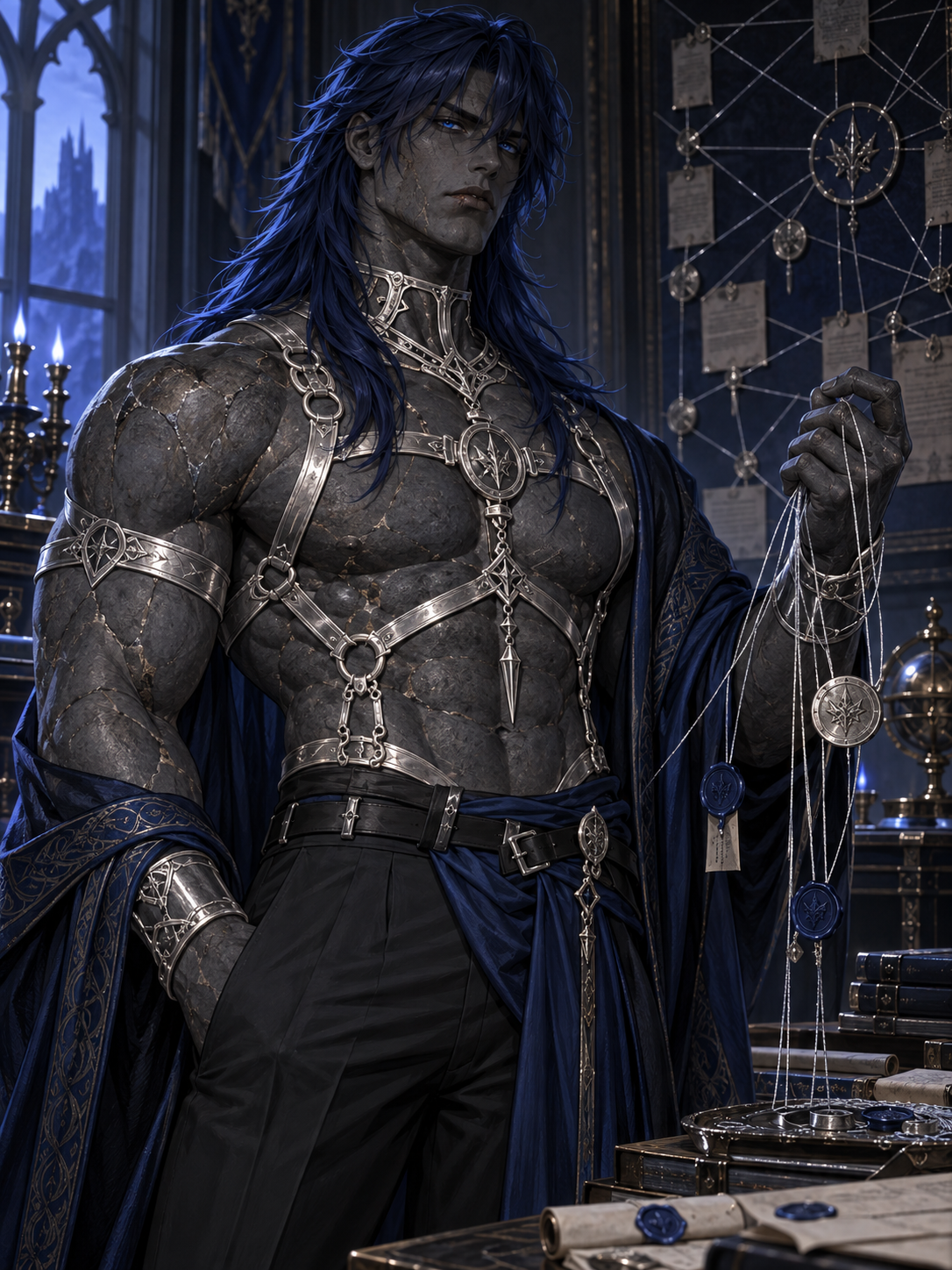
The Weaver
Entanglement // Influence // Exploitation
Mikhail is less playfully seductive than quietly inescapable. He looks sculpted, controlled, and immovable.
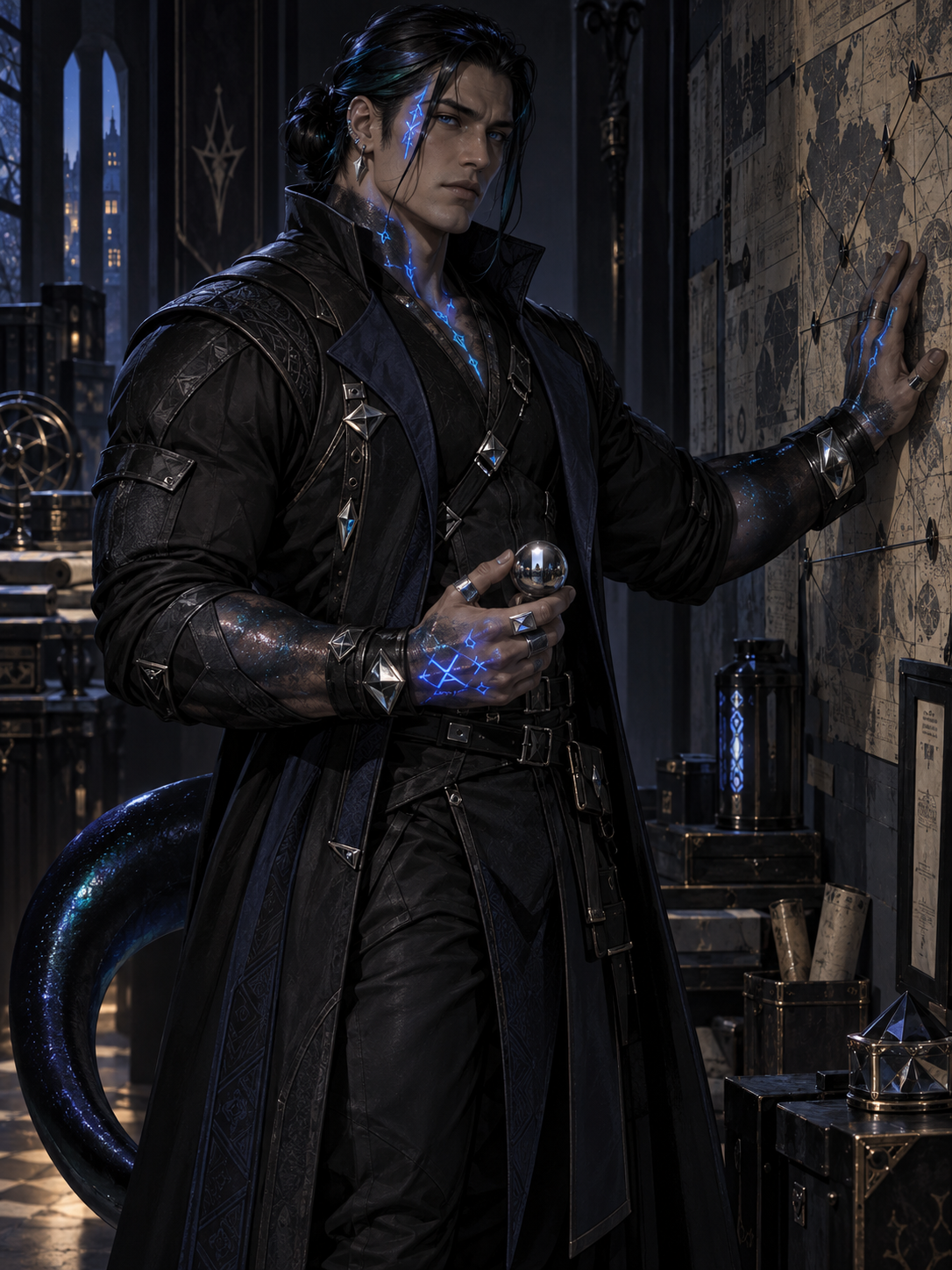 Seat IV // Knowledge
The Shadow
Intelligence // Surveillance // Target Acquisition
Viktor appears touched by something beyond ordinary Aetherian magic. Whether the rifts changed him, he used them, or he was never what he claimed remains secret.
 Seat V // Structure
The Matron
Captivity // Conditioning // Administration
Lorelei looks lawful. Not kind and not safe, but legitimate. She presents herself as an institution given a body.
Kraven controls through force. Tristan through need. Mikhail through dependency. Viktor through knowledge. Lorelei through structure.
Five separate holdings, five specialties, and one network built to make every form of captivity profitable.
Known Persons // Settlement Records // Threat Files
Leaders, keepers, scavengers, traders, protectors, criminals, and survivors. Select any portrait to open the character's current record.
Syndicate Leadership
The five Thornlords appear here as members of the cast. Their full operations, holdings, and Nexus Gates remain documented in the Bloodthorns section.
The BrokerNegotiation // Distribution // Wealthy Clients
Tristan makes exploitation sound like opportunity. He controls through need, debt, scarcity, hospitality, and transactions presented as willing bargains.
The ButcherAbduction // Raids // Armed Enforcement
Kraven directs the violent acquisition and initial intake of captives. His brutality is disciplined, experienced, and supported by strong logistics.
The MatronCaptivity // Conditioning // Administration
Lorelei presents herself as an institution given a body. Her seal turns transfers, discipline, deprivation, and identity erasure into ordinary administration.
The ShadowIntelligence // Surveillance // Target Acquisition
Viktor controls information, infiltration, informants, and forgery. Even his true relationship with the rifts remains uncertain.
The WeaverDependency // Influence // Exploitation
Mikhail oversees coercive establishments and influential clients. His systems use social pressure, enchantment, dependency, and manufactured consent.
Sanctuary Records // Part One
Leadership, defense, medicine, infrastructure, and the people who make the sanctuary function as more than a hiding place.
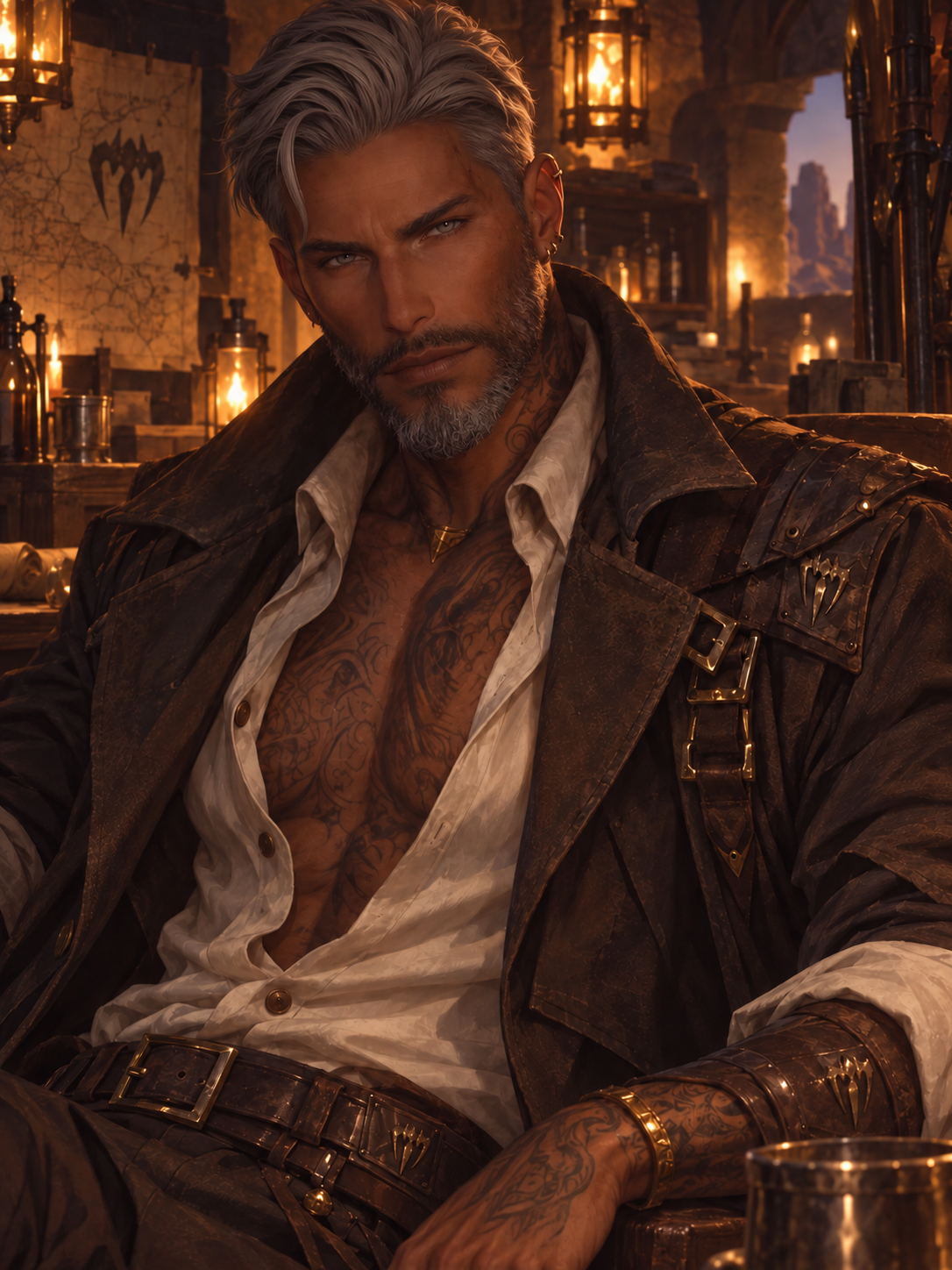 Founder // Hollow Fangs
 Settlement Leader // Former Mercenary
Founder and primary leader of the Hollowed Grounds, leader of the Hollow Fangs, and steward of the Hollow Fang Tavern. His controlled authority and reputation help hold the sanctuary together.
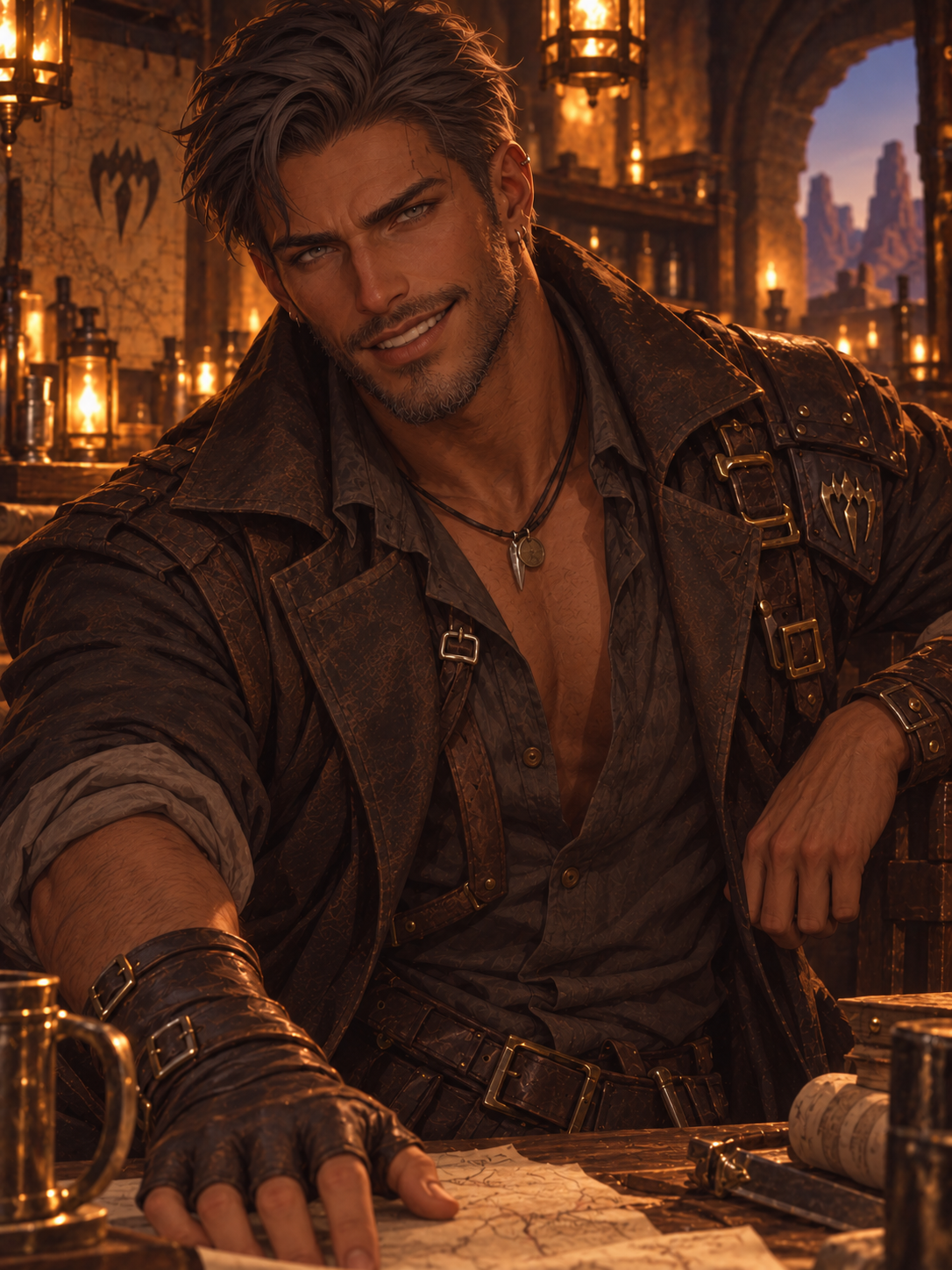 Hollow Fangs
Second-in-Command
Axel's eldest son combines tactical responsibility with greater social ease. He resembles a younger, rowdier version of his father and smiles far more often.
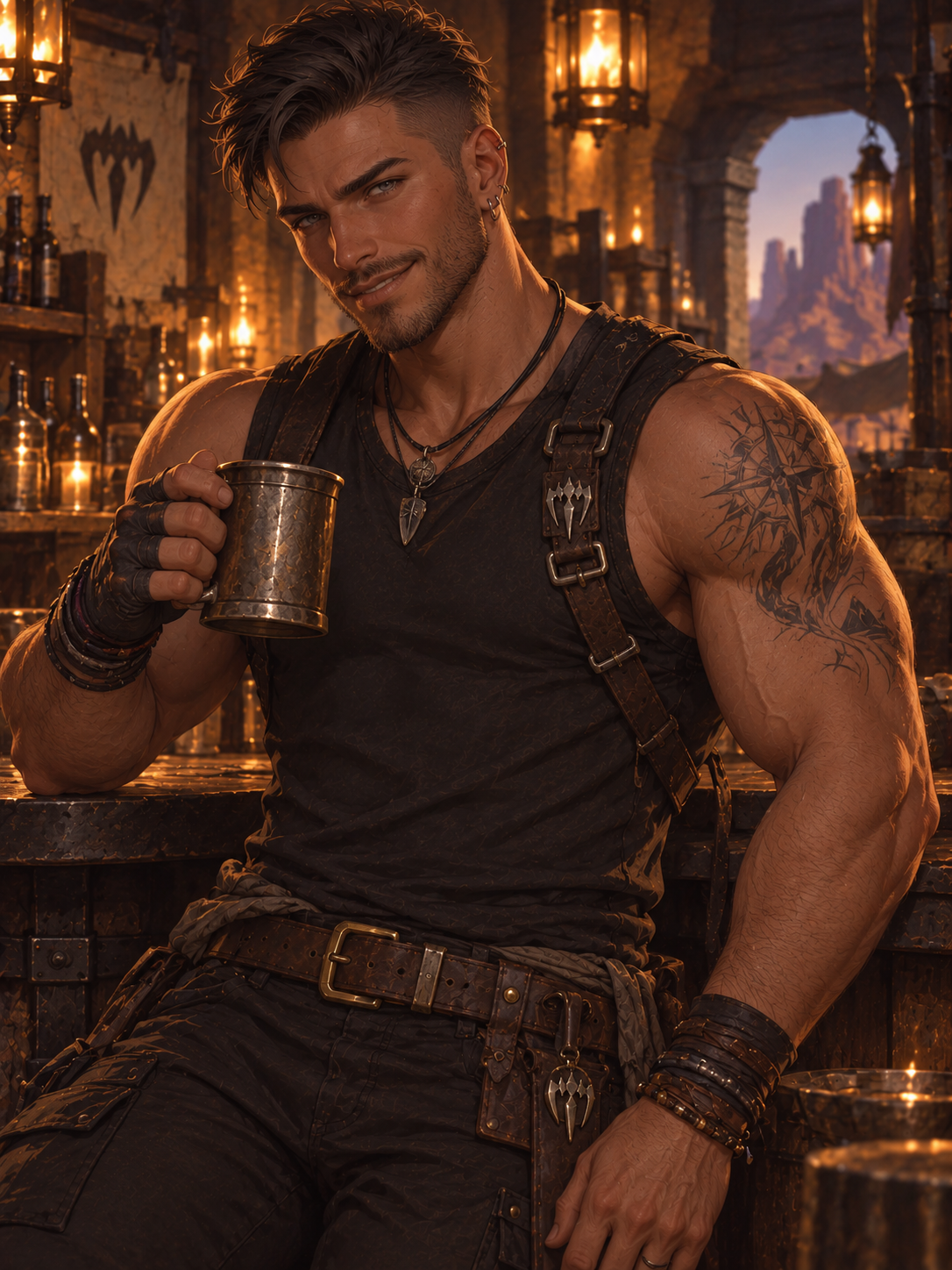 Hollow Fangs
Scout Leader // Tavern Bouncer
Axel's twenty-four-year-old son is warm-hearted, approachable, and visibly troublesome. Beneath that ease is a dangerous and experienced field operative.
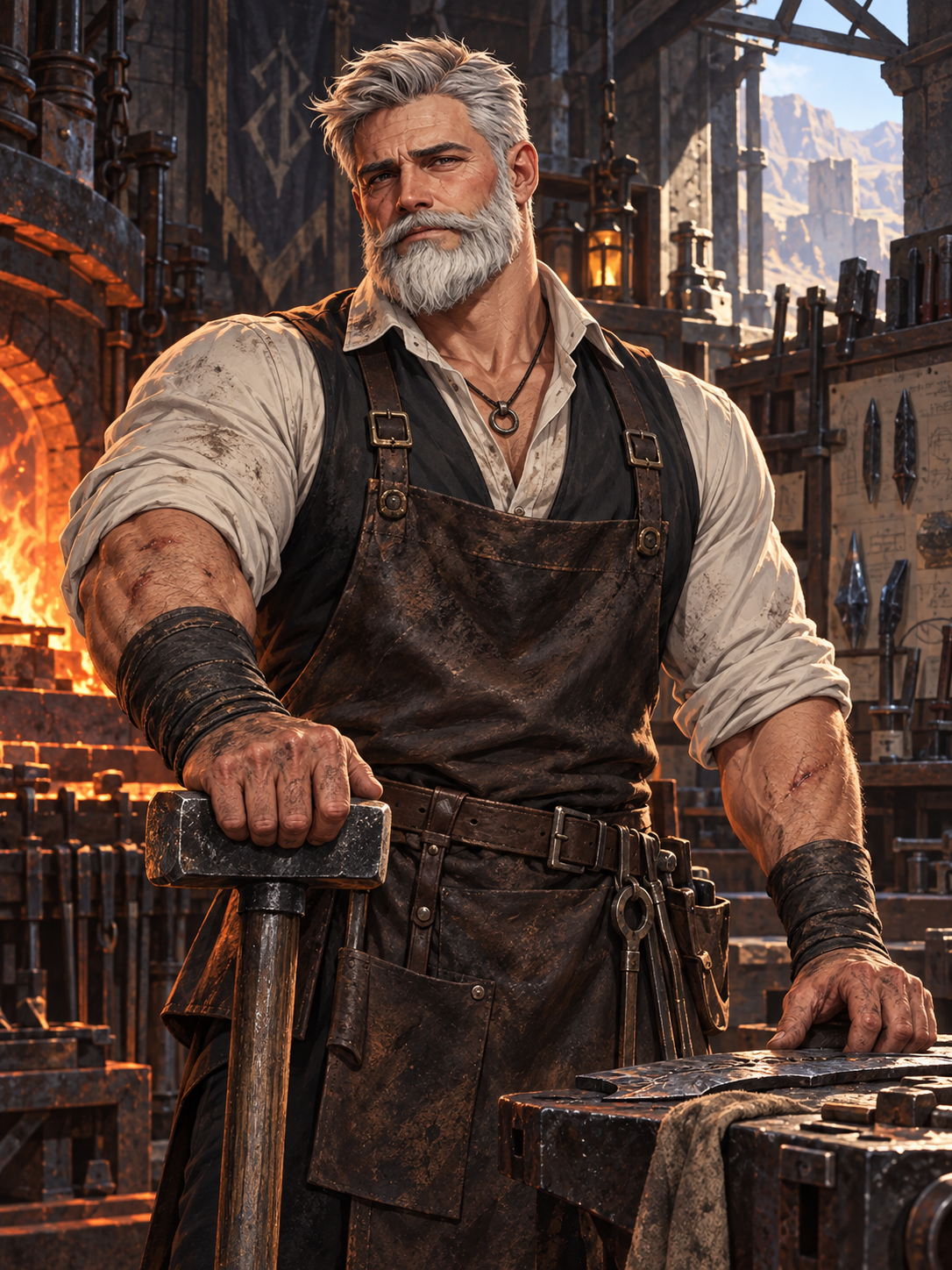 Smithy
Blacksmith // Enchanter // Engineer
Garran repairs critical infrastructure and develops defenses against specific Others. He supplies weapons, tools, ammunition, pumps, and expedition equipment.
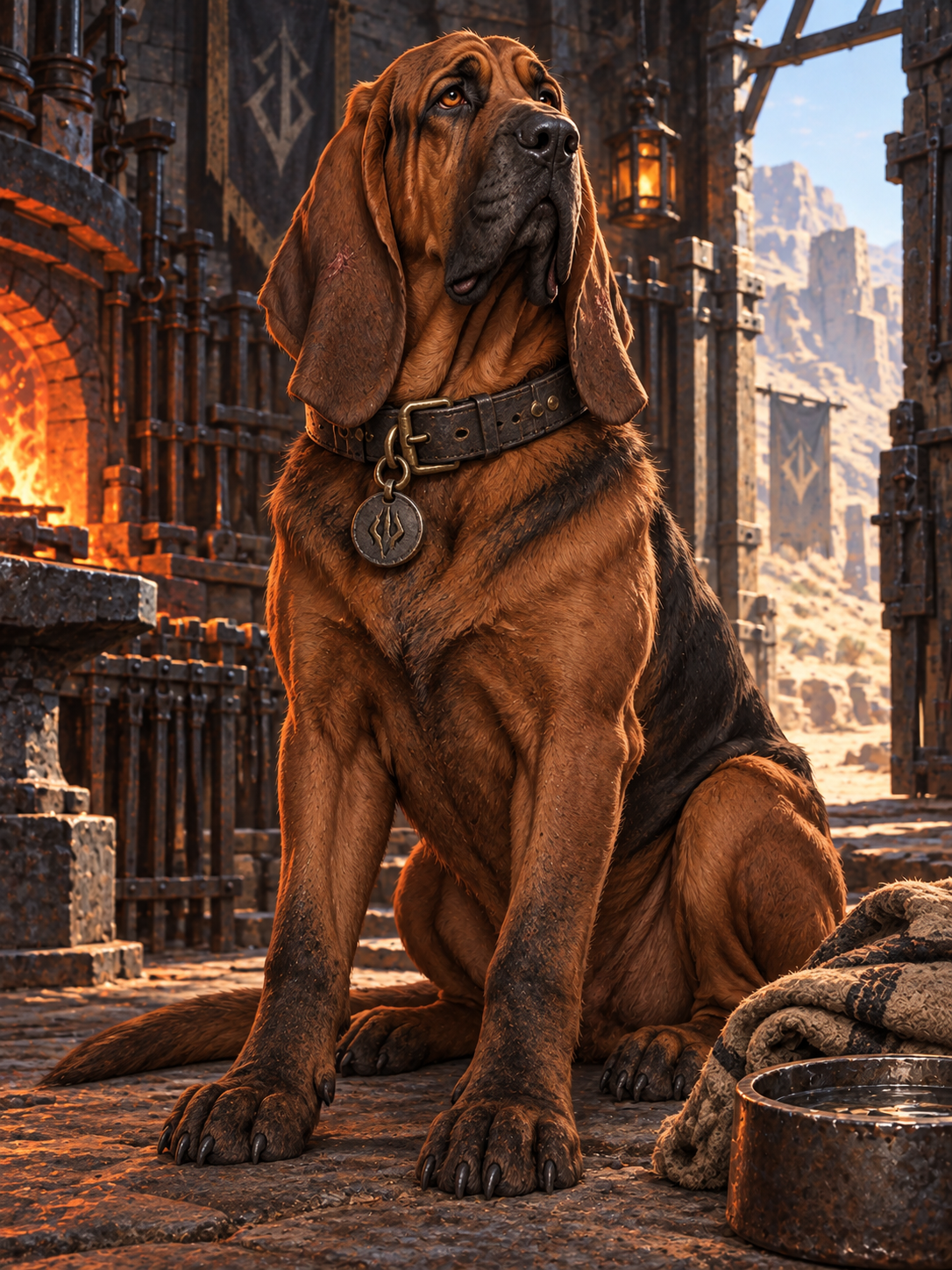 Smithy Guardian
Bloodhound Companion
Garran's large bloodhound companion accompanies him through daily work and guards the smithy. The settlement regards Brimstone as one of its own, not incidental livestock.
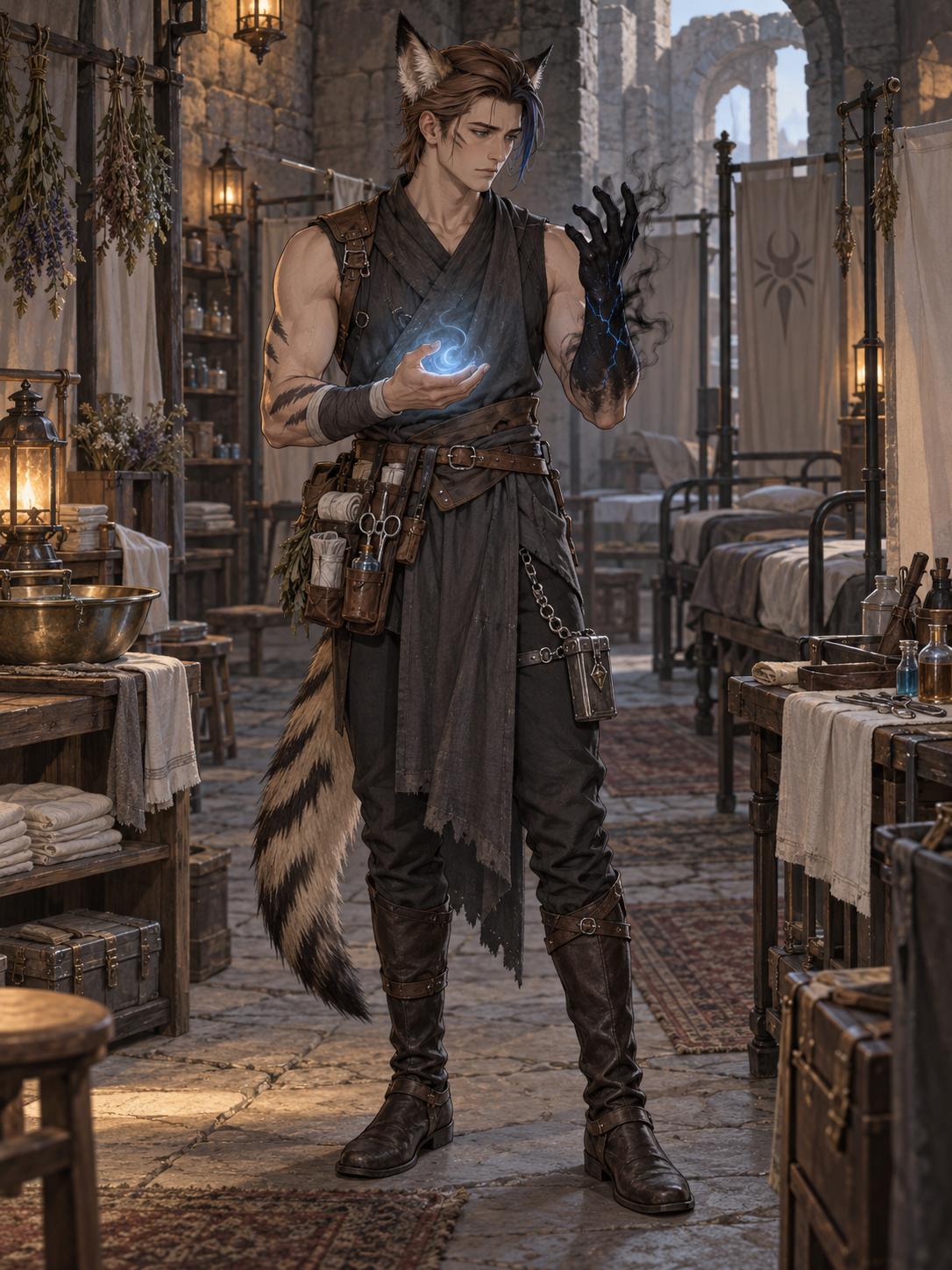 Infirmary
Primary Healer // Aardwolf Demi-Human
Drew treats trauma, illness, magical injuries, and rift contamination. His blackened left hand detects and draws corruption from wounds while his normal right hand heals the damage.
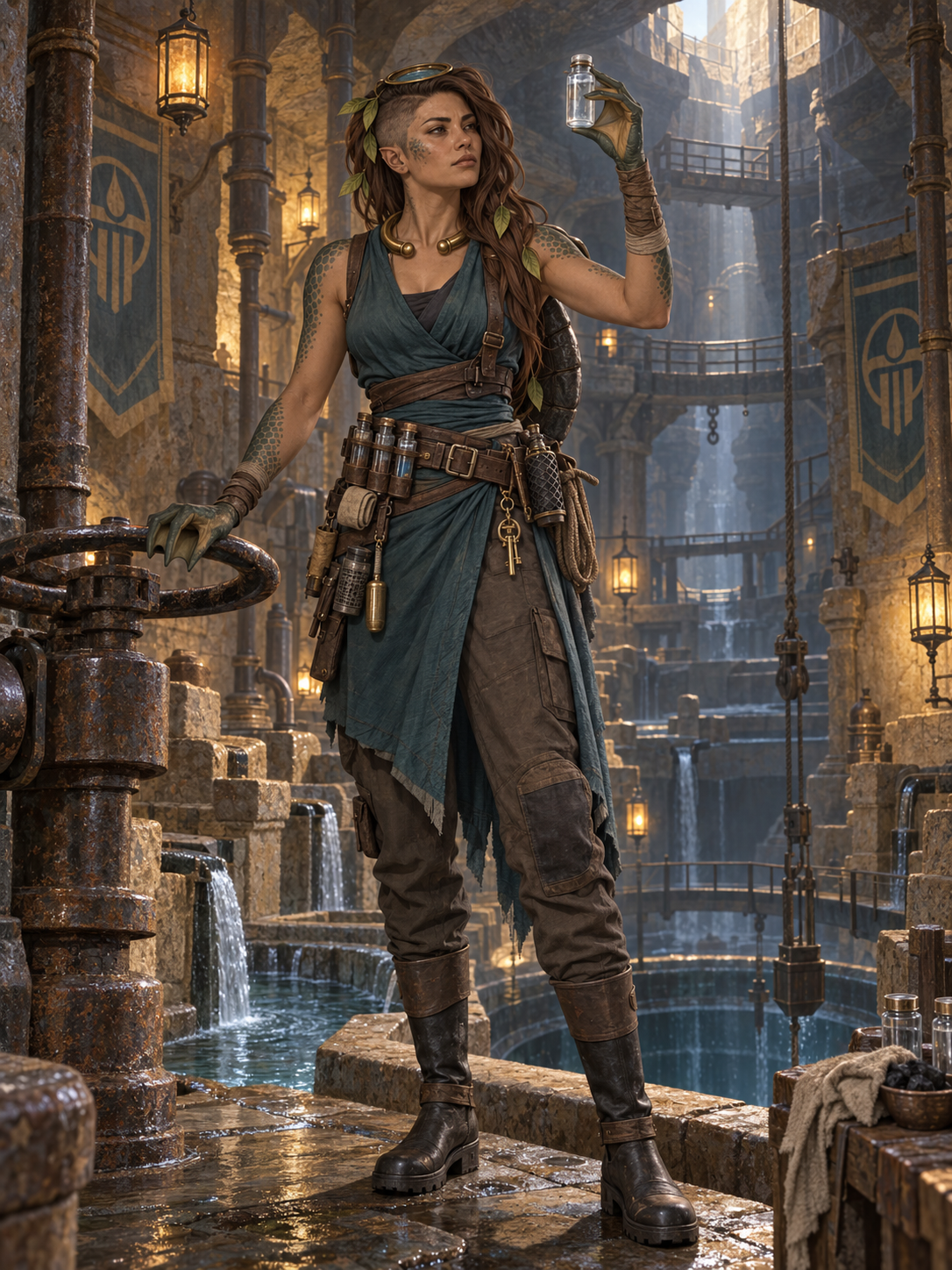 Waterworks
Water Keeper // Kappa Demi-Human
Kylie oversees the Deep Well, cisterns, filtration, sanitation safeguards, testing, and emergency rationing. During a water crisis, her authority supersedes ordinary settlement command.
 Refuge Quarter
Refuge Coordinator // Cattle Demi-Human
Kristov manages intake, shelter, supplies, reunification, quarantine, work placement, child protection, and infiltrator screening. Shelter comes first, judgment comes after evidence.
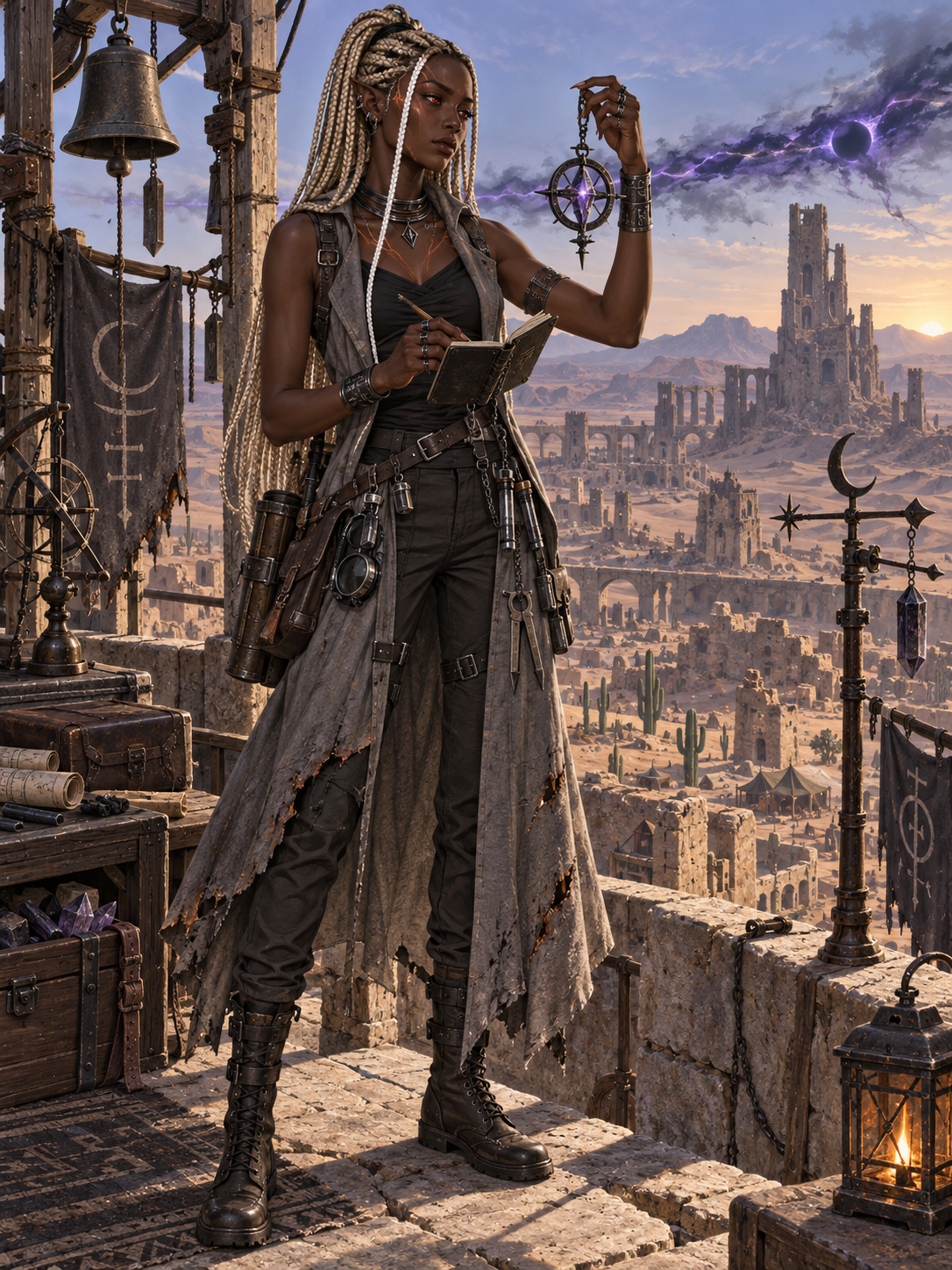 Rift Watch
Rift Watcher // Seelie Fae
Deja monitors magical pressure, developing wounds, and Other signatures. She can distinguish natural rifts from deliberately manipulated breaches, though she does not yet understand why.
Sanctuary Records // Part Two
The keepers, organizers, teachers, couriers, and troublemakers responsible for the sanctuary's daily survival.
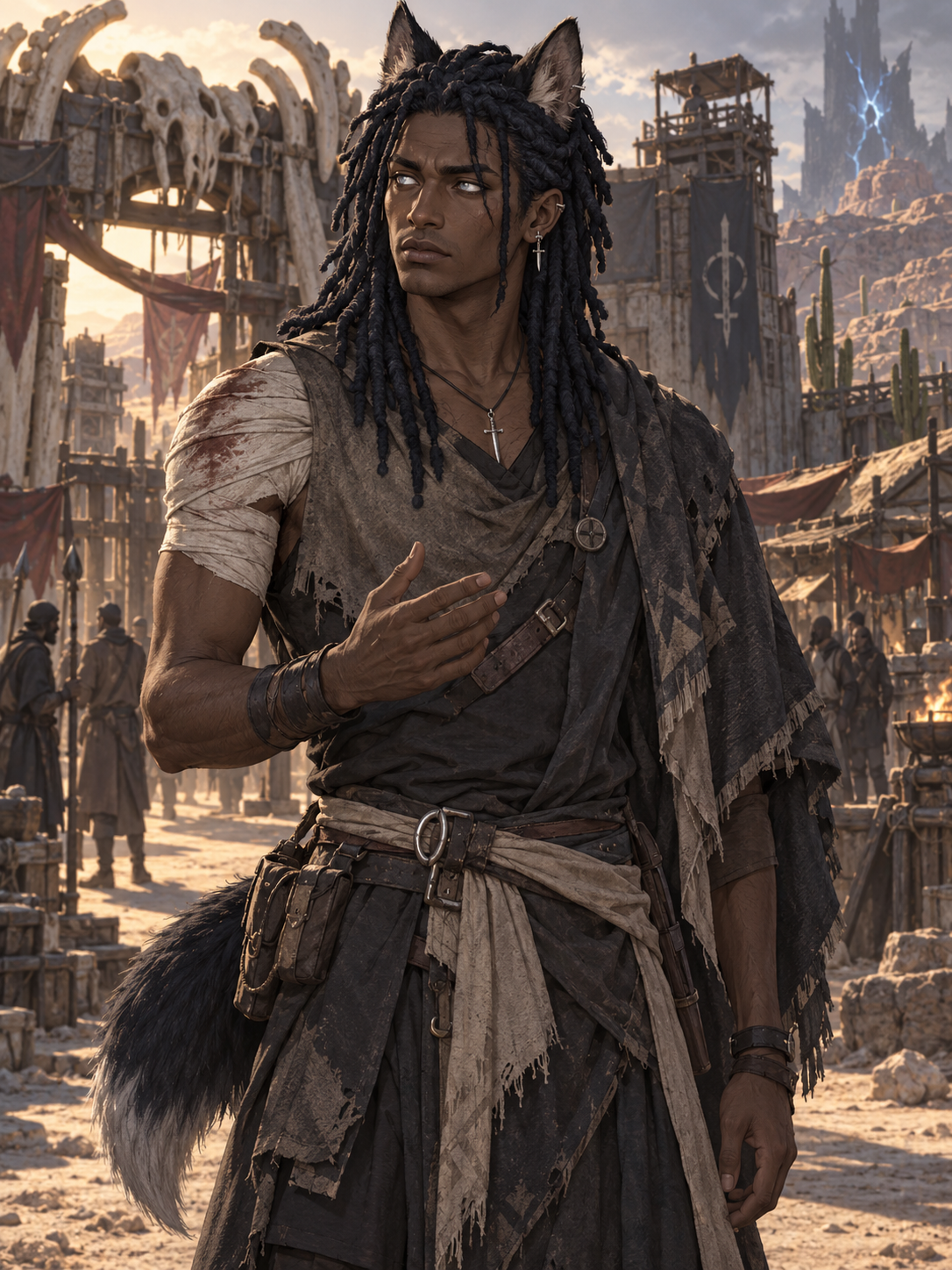 Public Hall
Settlement Representative // Dogman Demi-Human
Jordan receives grievances, mediates disputes, records public decisions, coordinates urgent assemblies, and manages first contact with outsiders at the gates.
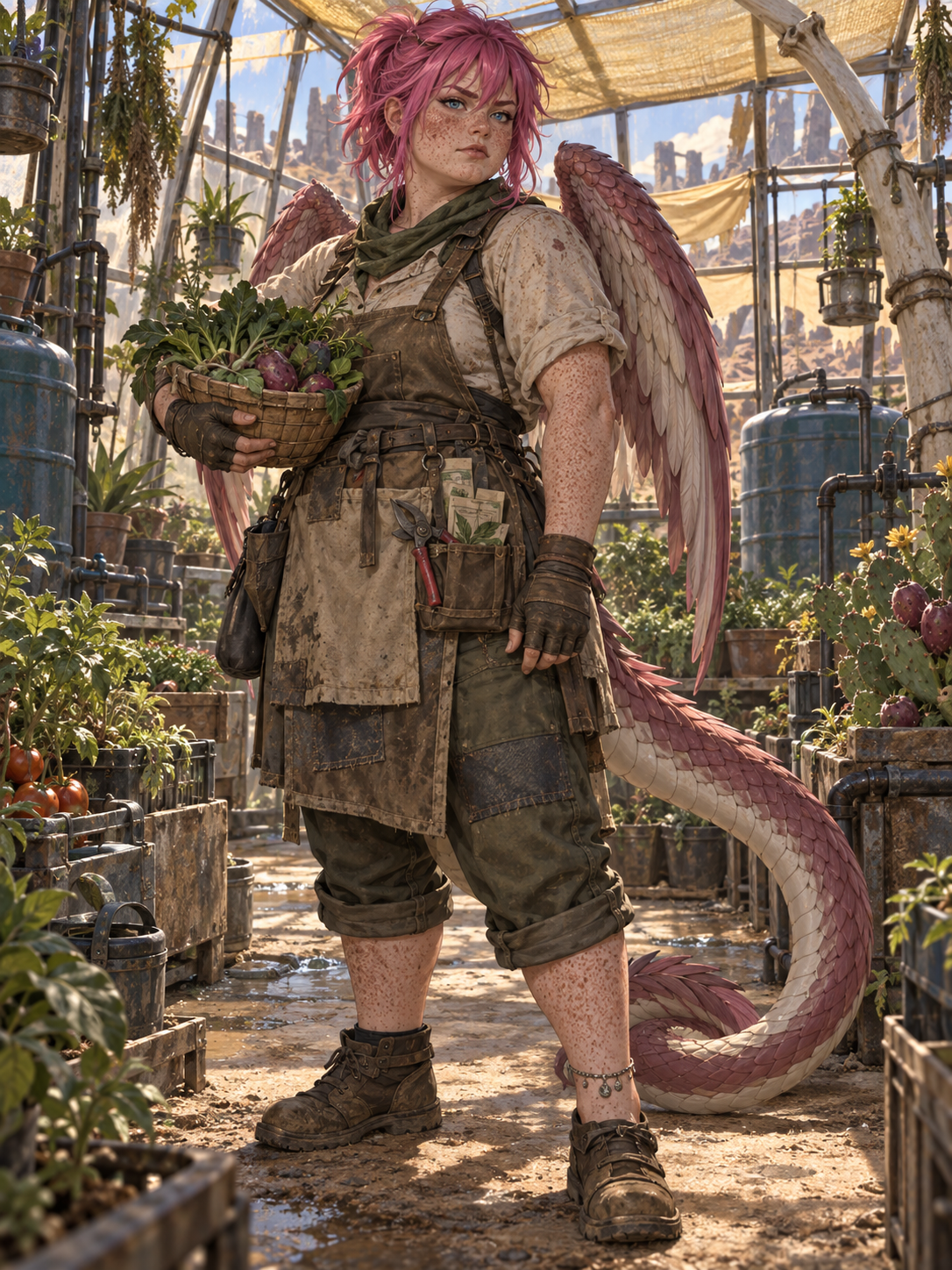 Growhouse
Growhouse Keeper // Amphithere Demi-Human
Willow maintains the greenhouse, seed stores, irrigation, soil beds, medicinal herbs, crop rotations, and drought-resistant food plants.
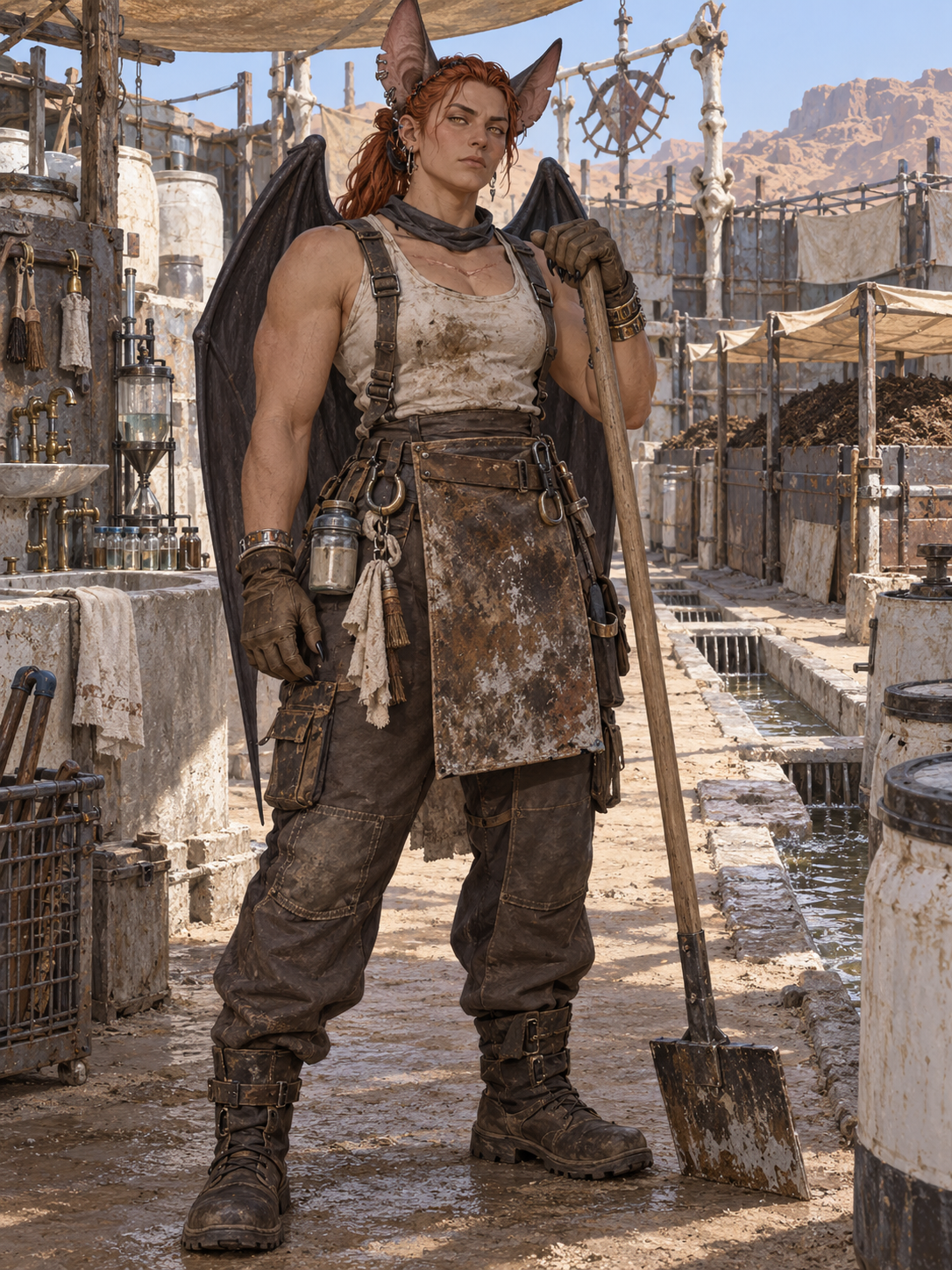 Sanitation Works
Sanitation Keeper // Werebat Demi-Human
Tamsin controls waste processing, drainage, wash stations, contaminated-material disposal, quarantine sanitation, and disease prevention.
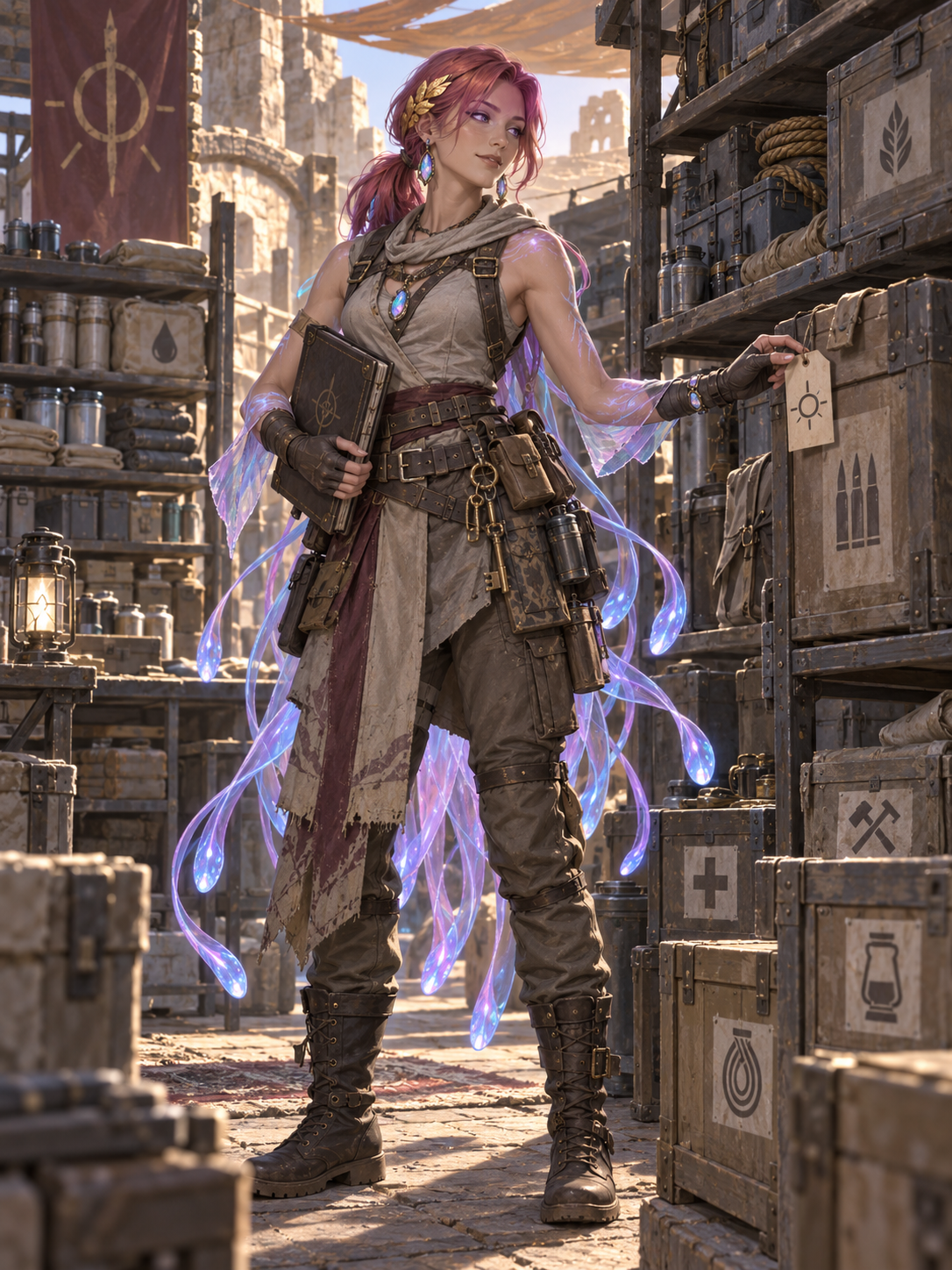 Central Stores
Quartermaster // Jellyfish Humanoid
Jazzy controls inventory, rations, expedition kits, weapons, ammunition, emergency reserves, repair priorities, and records of every missing supply.
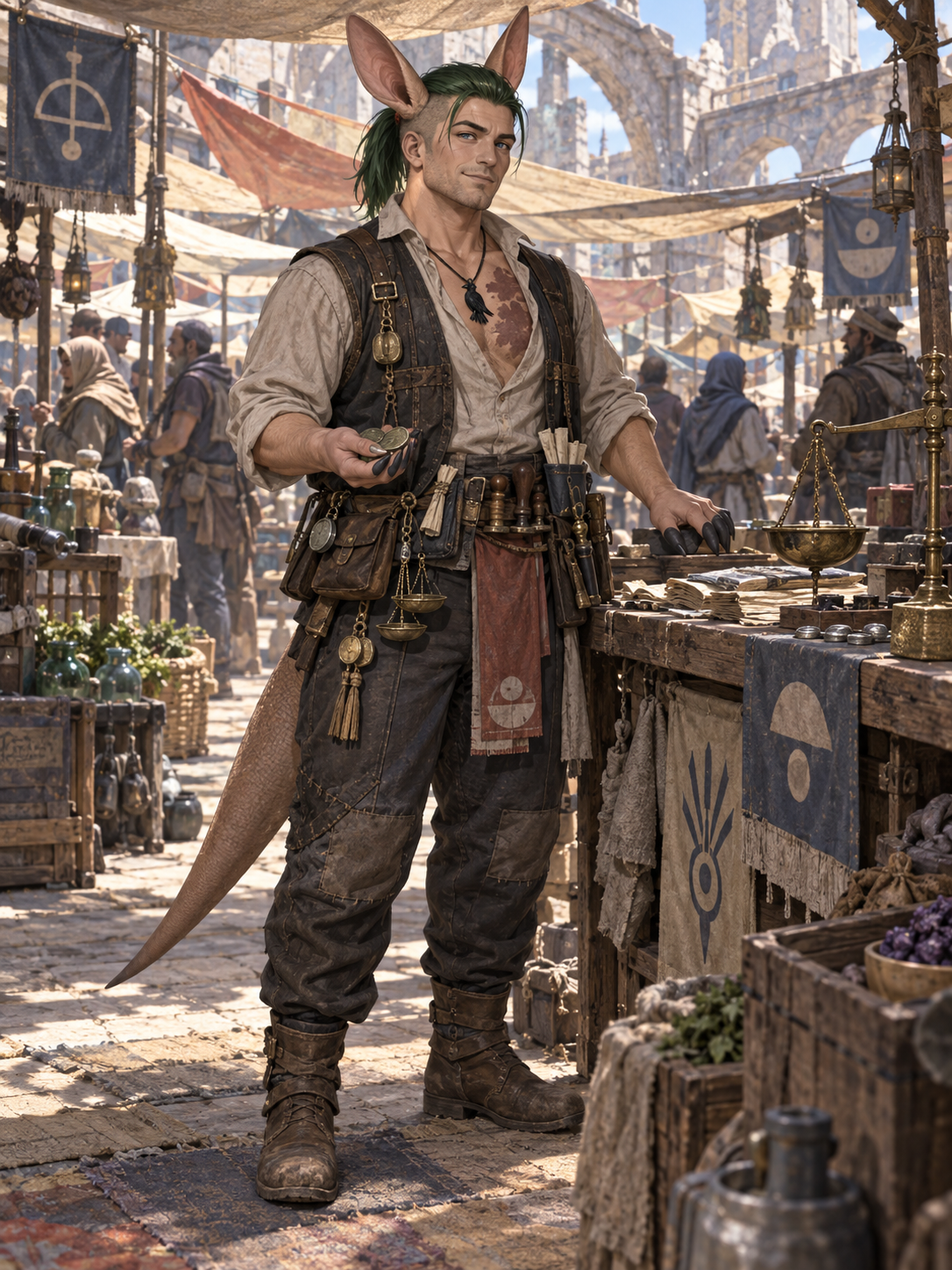 Market Quarter
Market Organizer // Aardvark Demi-Human
Jeff manages stalls, schedules, barter standards, vendor disputes, trader permits, price-gouging investigations, contraband reports, and shortage notices.
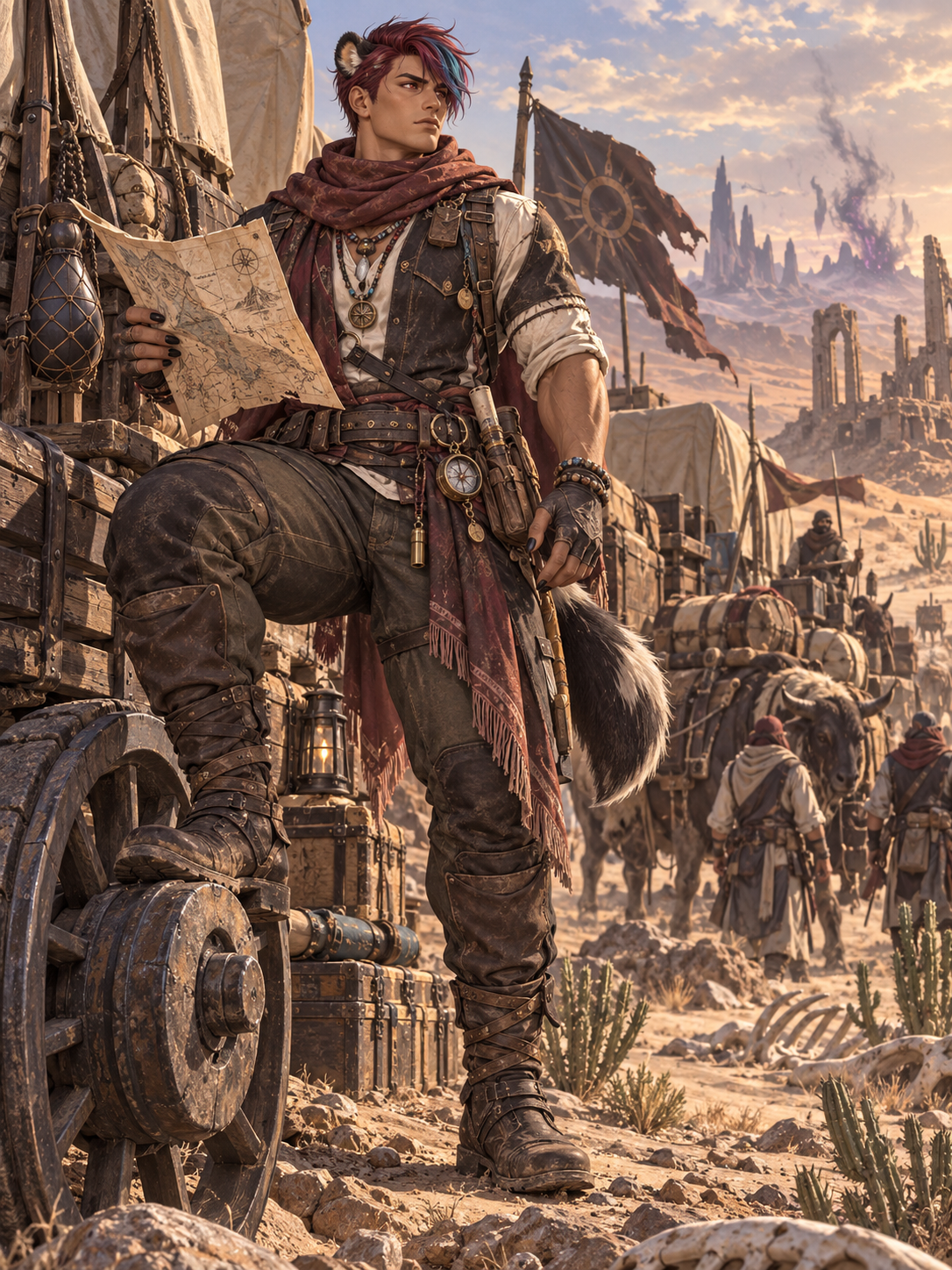 Caravan Yard
Caravan Leader // Honey Badger Demi-Human
Haru commands drivers, guards, scouts, and outriders. He chooses routes, calculates supplies, avoids rifts, coordinates repairs, and leads trade runs and evacuations.
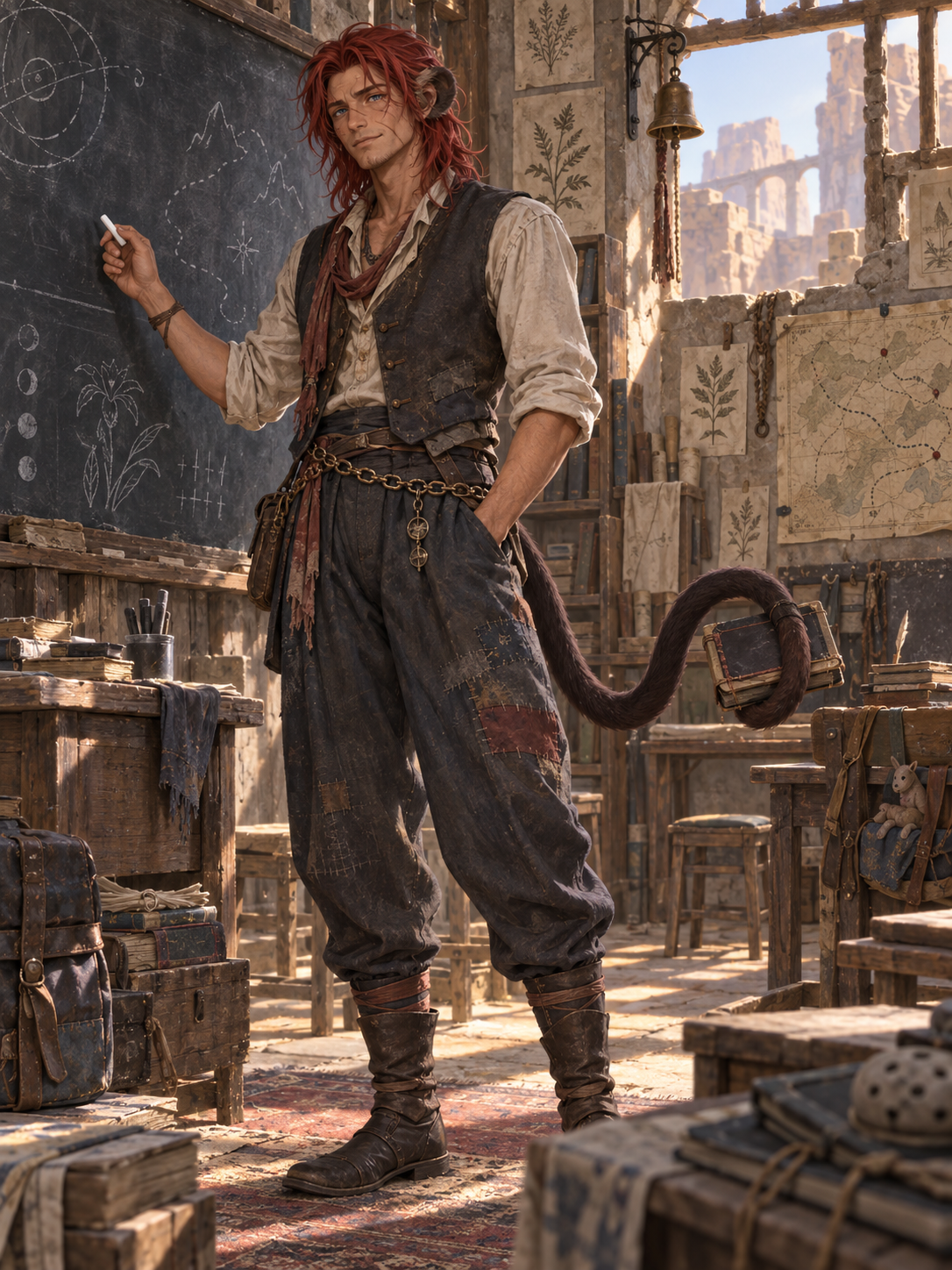 Schoolroom
Teacher // Spider-Monkey Demi-Human
Aki teaches literacy, arithmetic, geography, first aid, rift warnings, food and water safety, common Others, safe scavenging, and the history Aetharia omits.
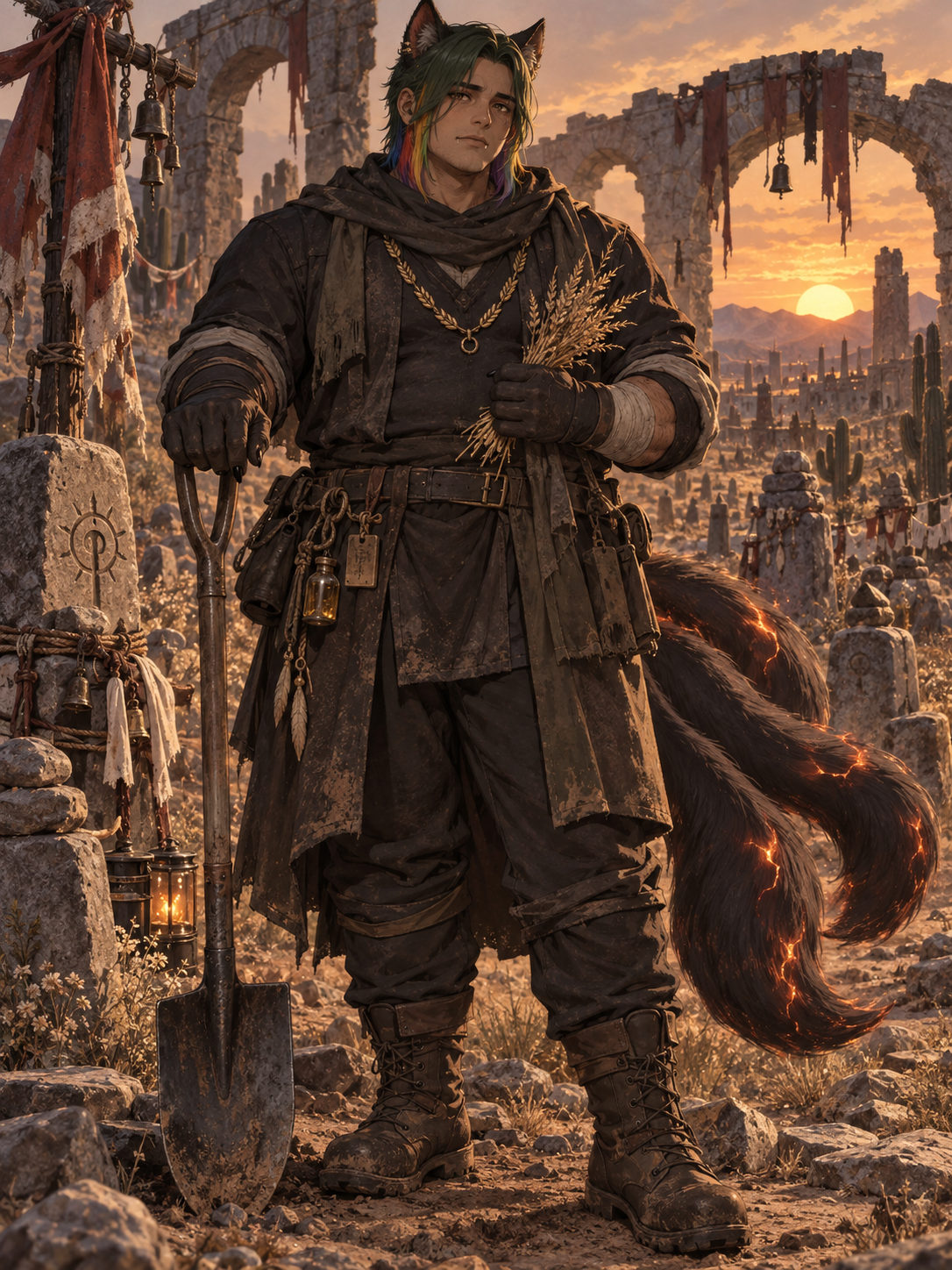 Burial Grounds
Burial Keeper // Cerberus Hellhound Demi-Human
Jace identifies remains, prepares graves and cairns, returns personal effects, accommodates varied rites, contains rift-tainted bodies, and maintains memorial bells.
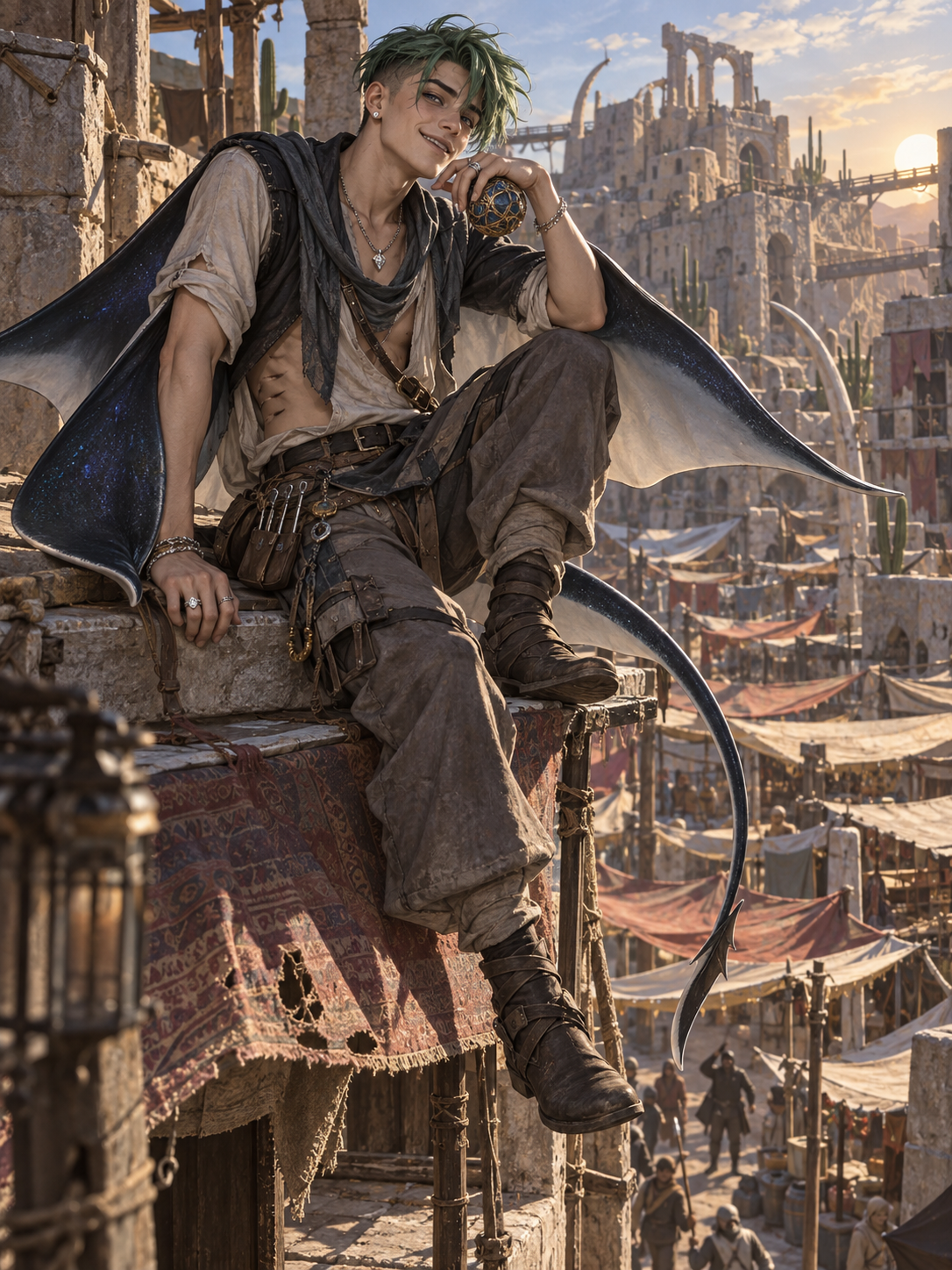 Local Menace
Troublemaker // Ray Humanoid
Cicero breaks into locked areas, exposes weak security, races rooftops, redirects signs, uncovers secrets, and smuggles harmless luxuries into the Refuge Quarter.
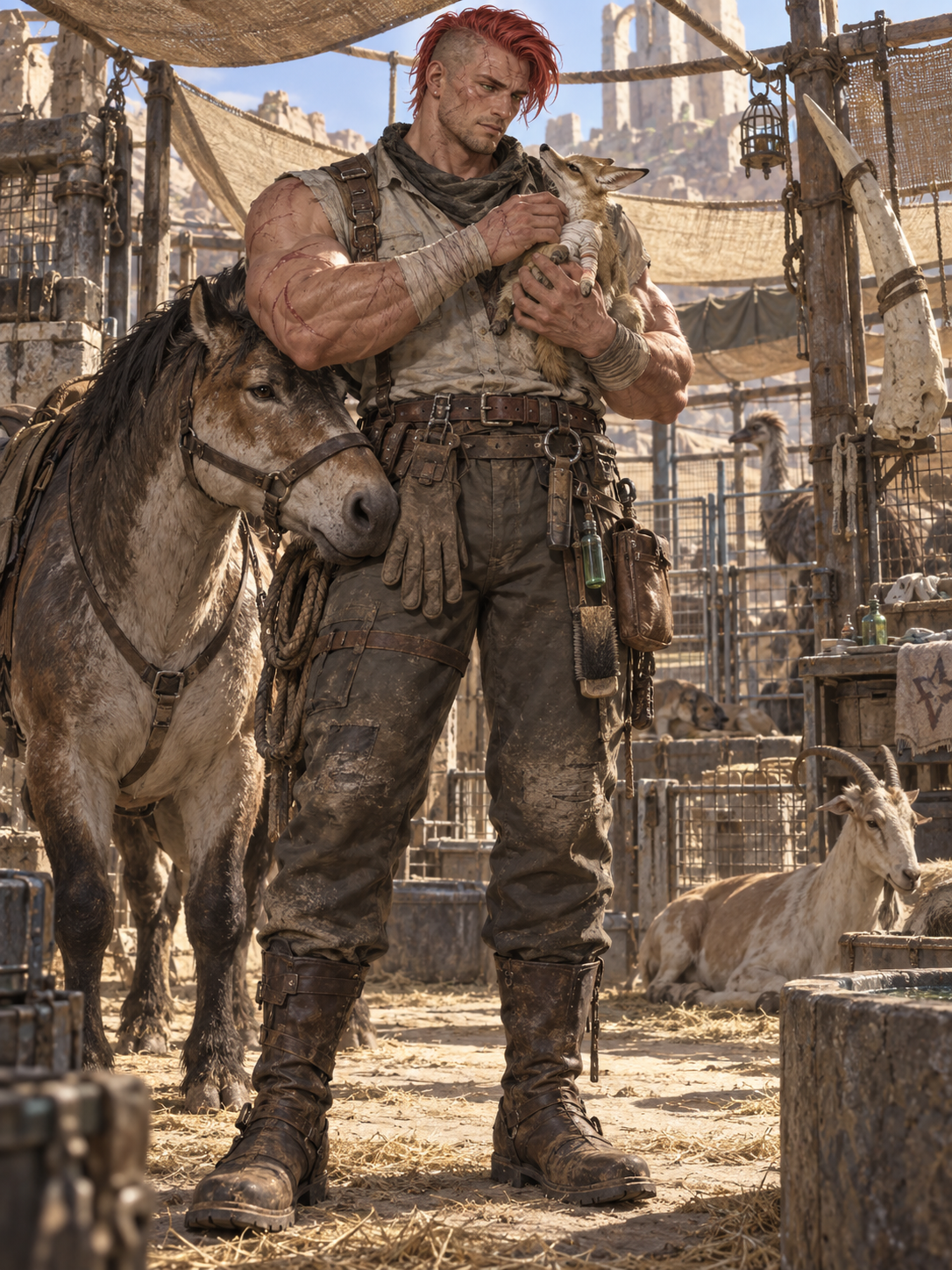 Animal Yards
Animal Keeper // Human
Kalen cares for working animals and injured wildlife, manages quarantine and feed, tests temperaments, repairs enclosures, and identifies creatures altered by rifts.
Trade // Salvage // Defense
Three brothers tied to the Hollowed Grounds, each handling a different part of what must leave the walls and what must return.
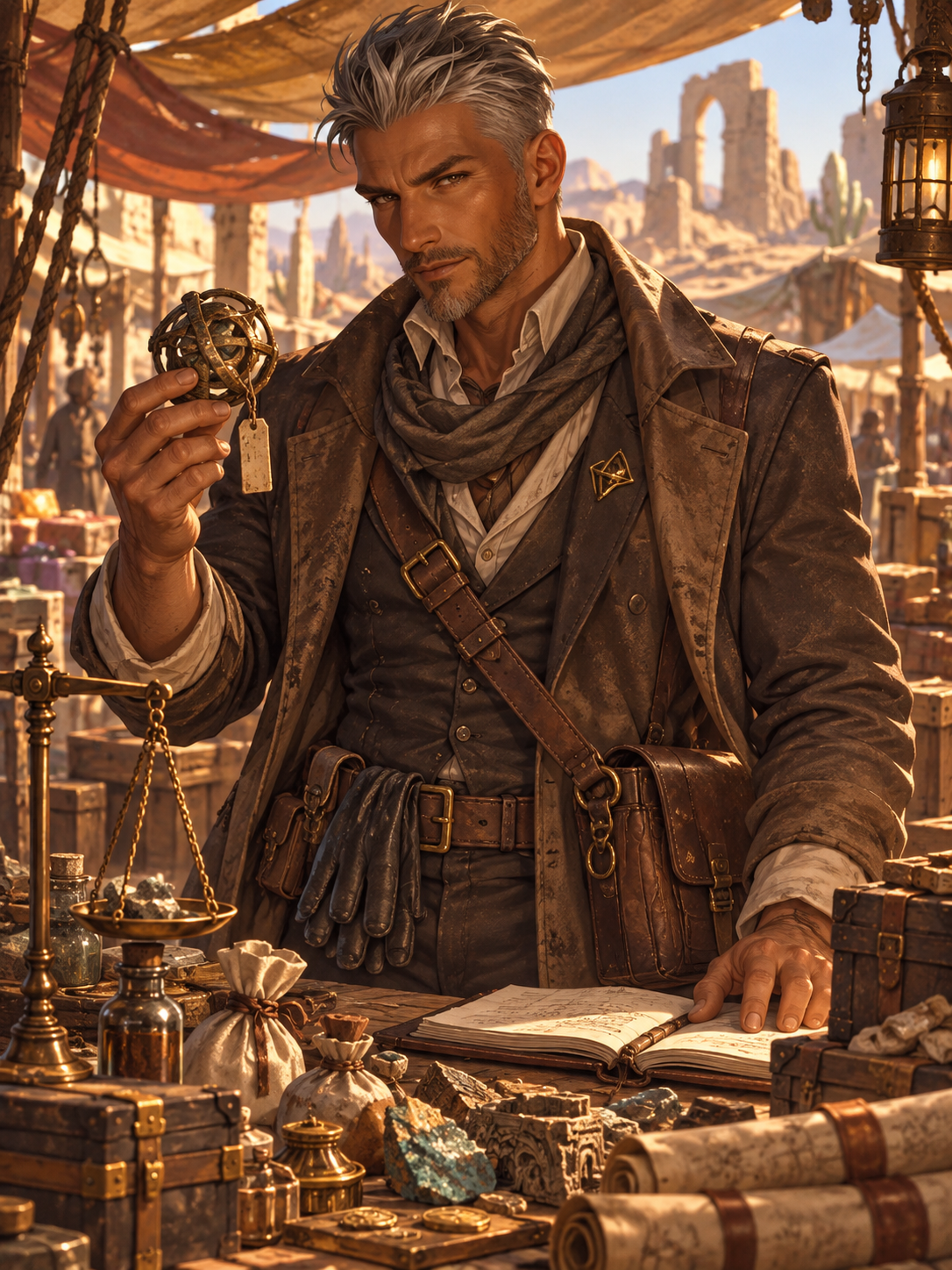 The Trader
Trader // Information Broker
Daniel turns recovered goods into resources the settlement cannot produce. He manages negotiation, exchange, outside contacts, rare goods, and regional intelligence.
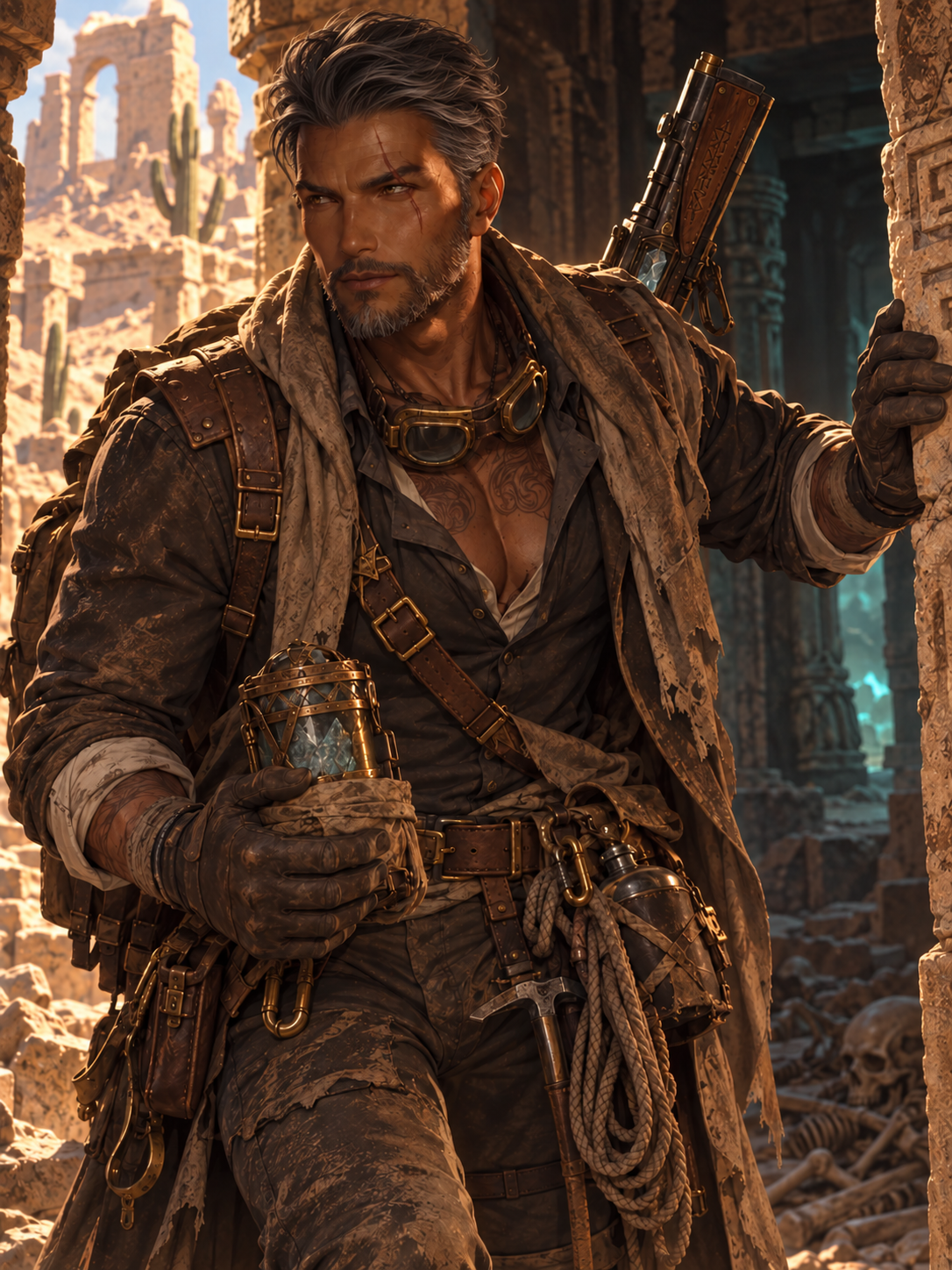 The Scavenger
Ruin-Crawler // Salvager
David enters abandoned settlements, rift-damaged structures, and buried infrastructure to recover supplies, artifacts, and trade goods worth bringing home.
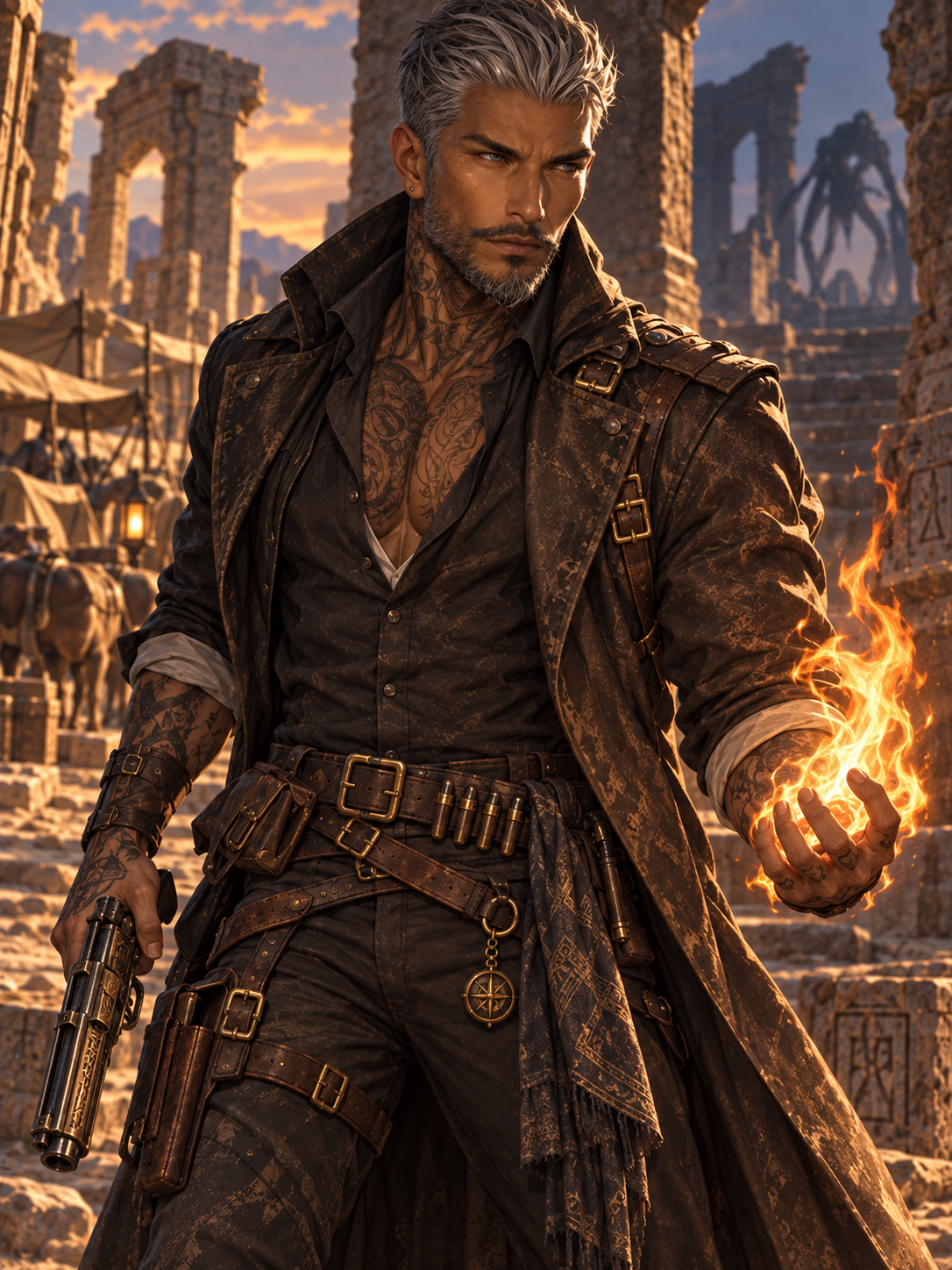 The Enforcer
Defender // Flame Mage
Armed with a gun and flame magic, Dorian handles human threats and approaching Others. He has both the temperament and willingness to shoot when necessary.
Mobile Scavenging Crew
A mobile crew built for dangerous ruin work. Their roles overlap during disasters, but each carries expertise the others cannot replace.
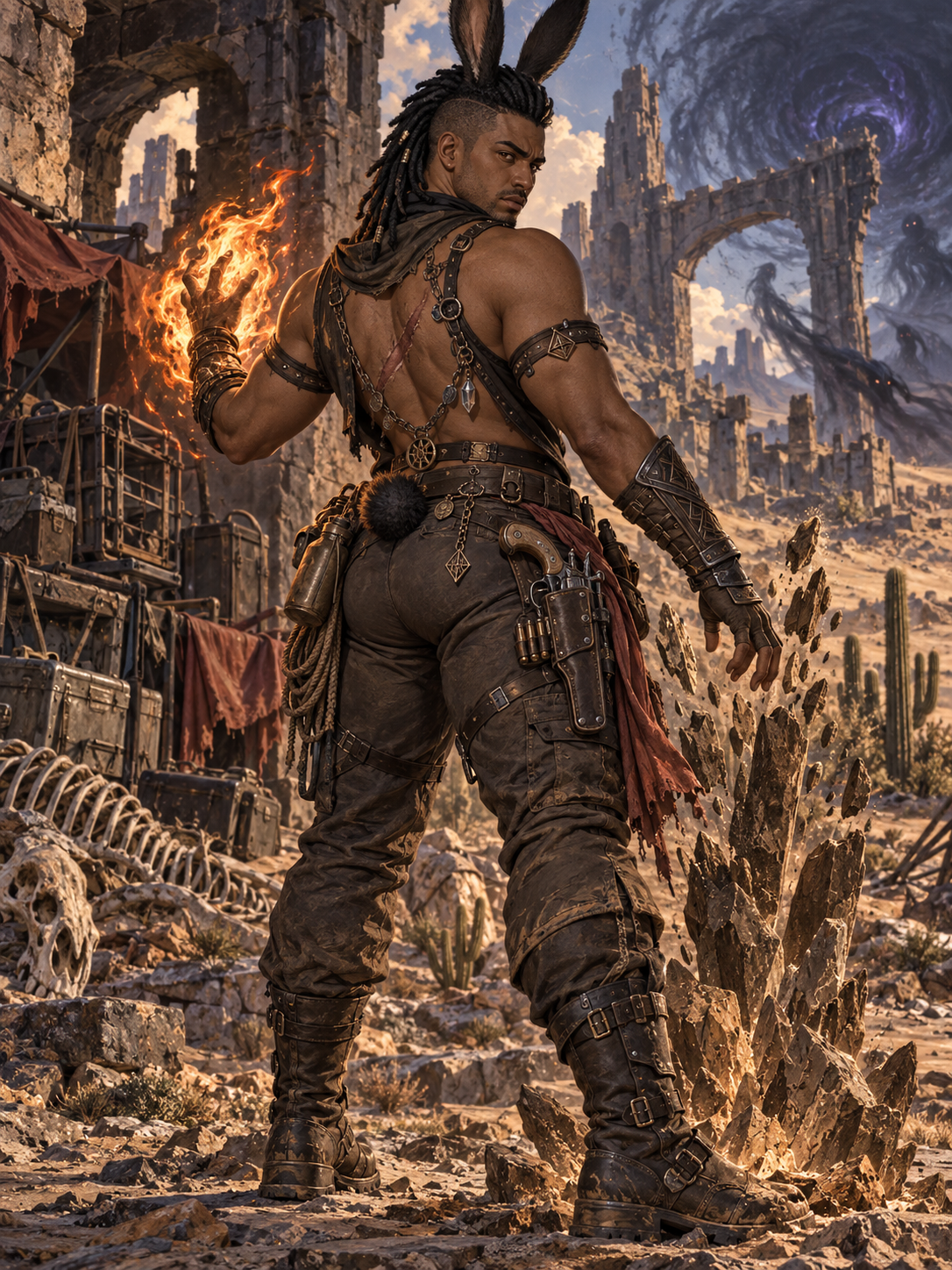 Crew Protection
Rabbit Demi-Human // Fire and Earth Mage
Cory guards the perimeter, identifies ambushes, protects Moo during treatment, and forces retreats with gunfire, stone, and flame when salvage becomes too dangerous.
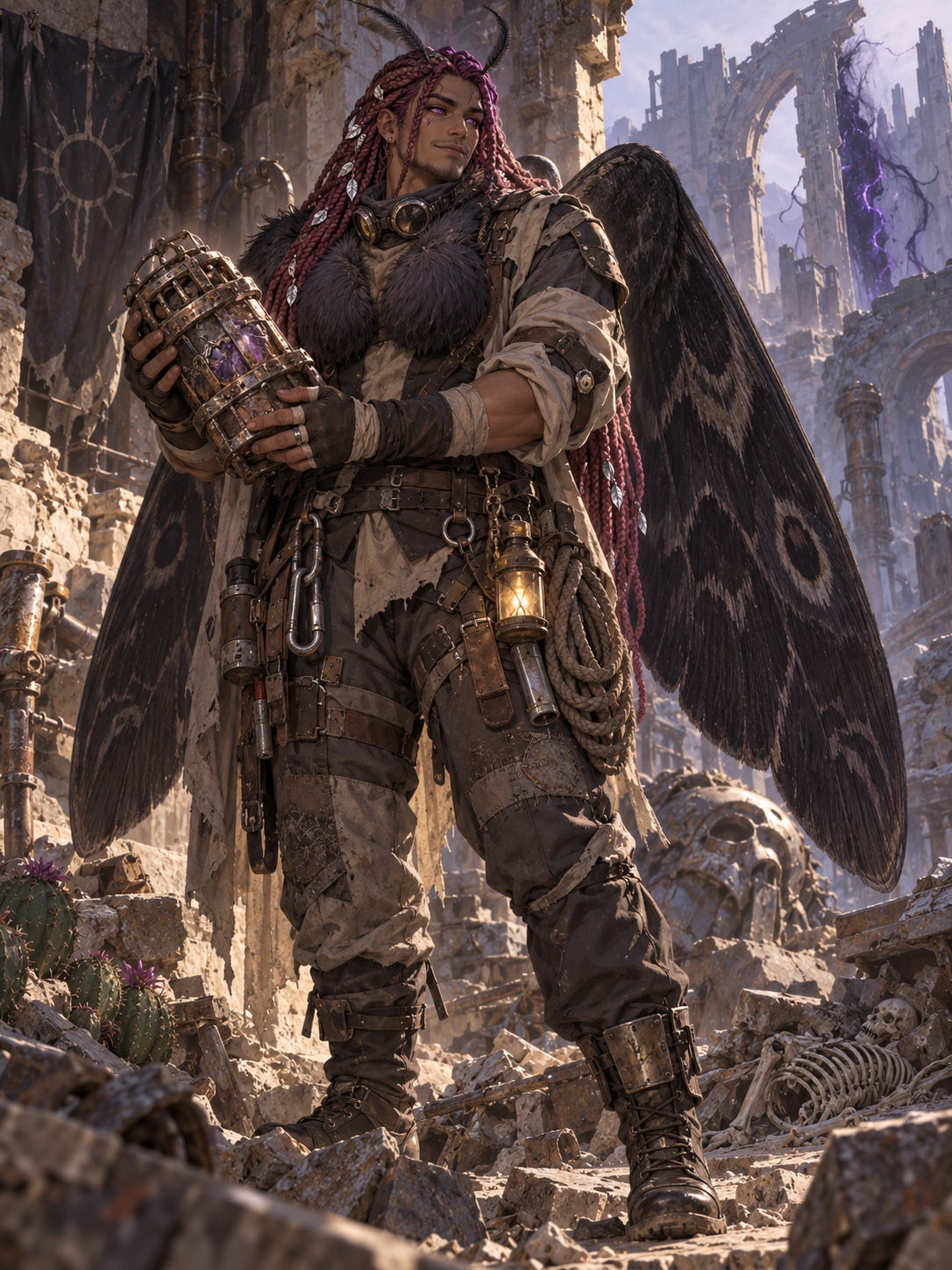 Heavy Salvage
Mothman Demi-Human // Extraction Specialist
Dusty evaluates unstable ruins, dismantles machinery, detects traps, extracts structural components and sealed relics, and decides what is worth transporting.
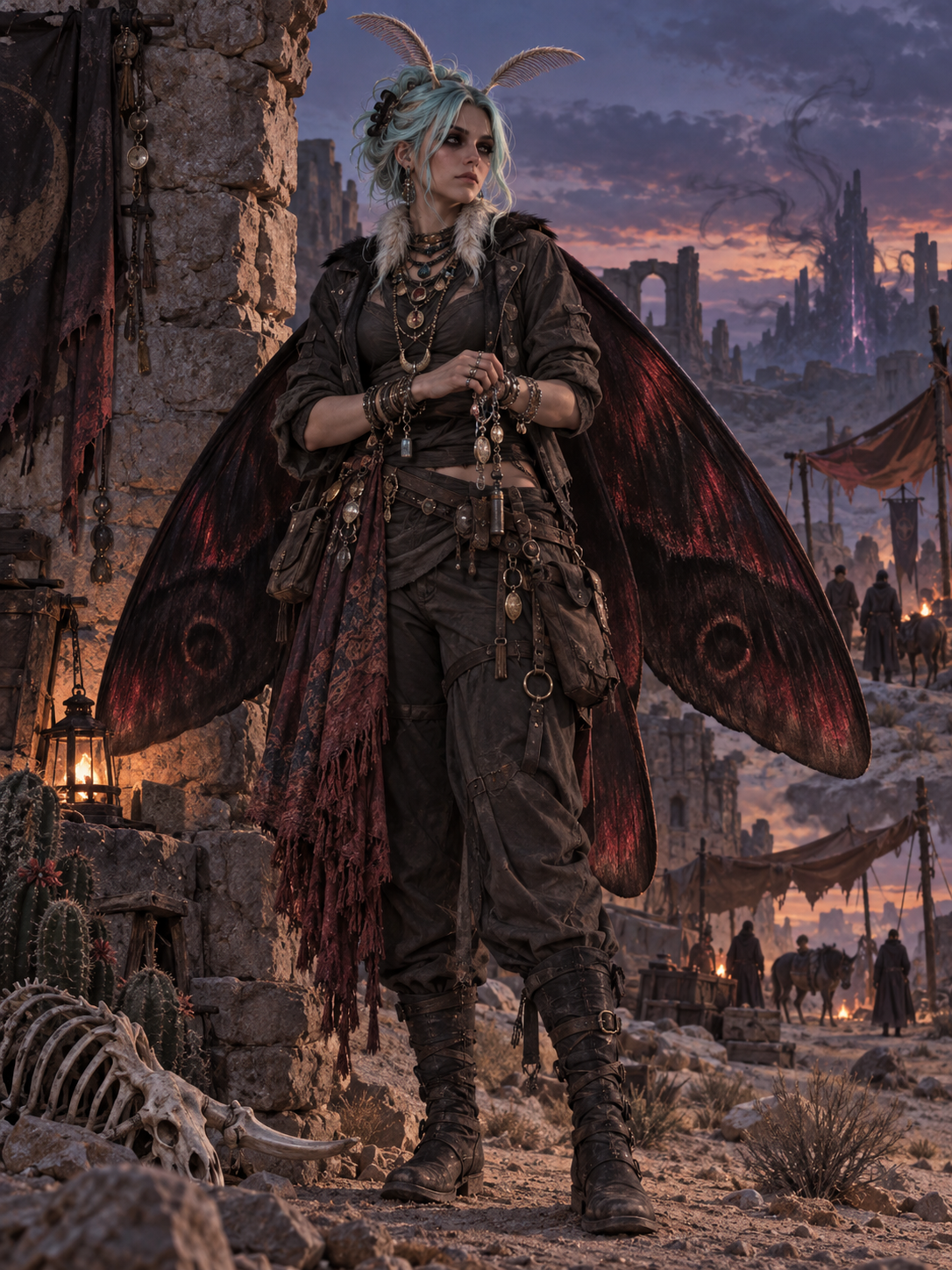 Scavenger
Lunar-Moth Demi-Human // Cache Finder
Jack searches narrow and unstable spaces, locates concealed caches, identifies portable valuables, and climbs where Dusty's extraction equipment cannot follow.
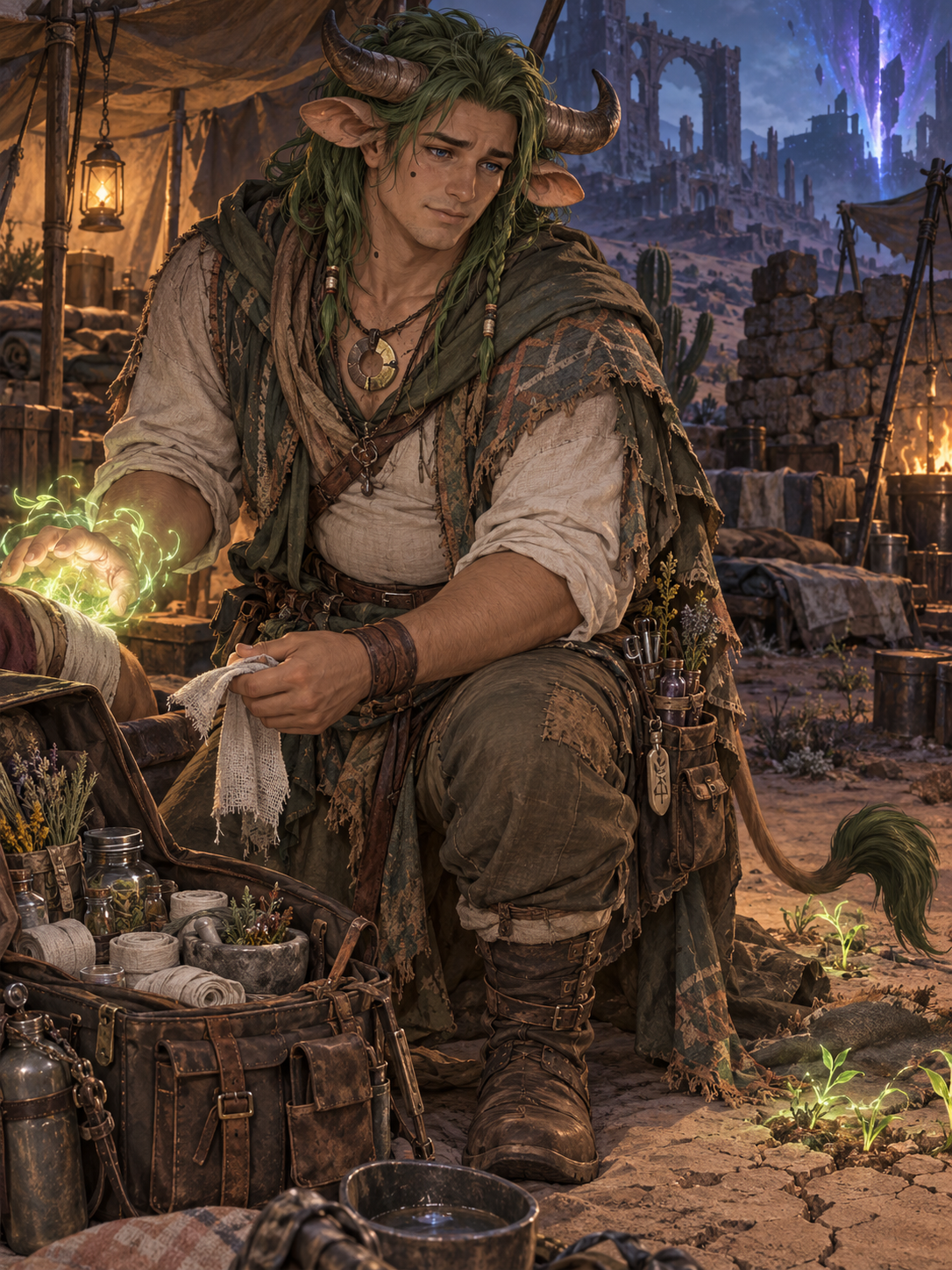 Field Medicine
Minotaur Demi-Human // Druidic Healer
Moo treats trauma, poison, infection, magical injury, and rift exposure. He determines when the wounded can be moved and has final authority over medical retreats.
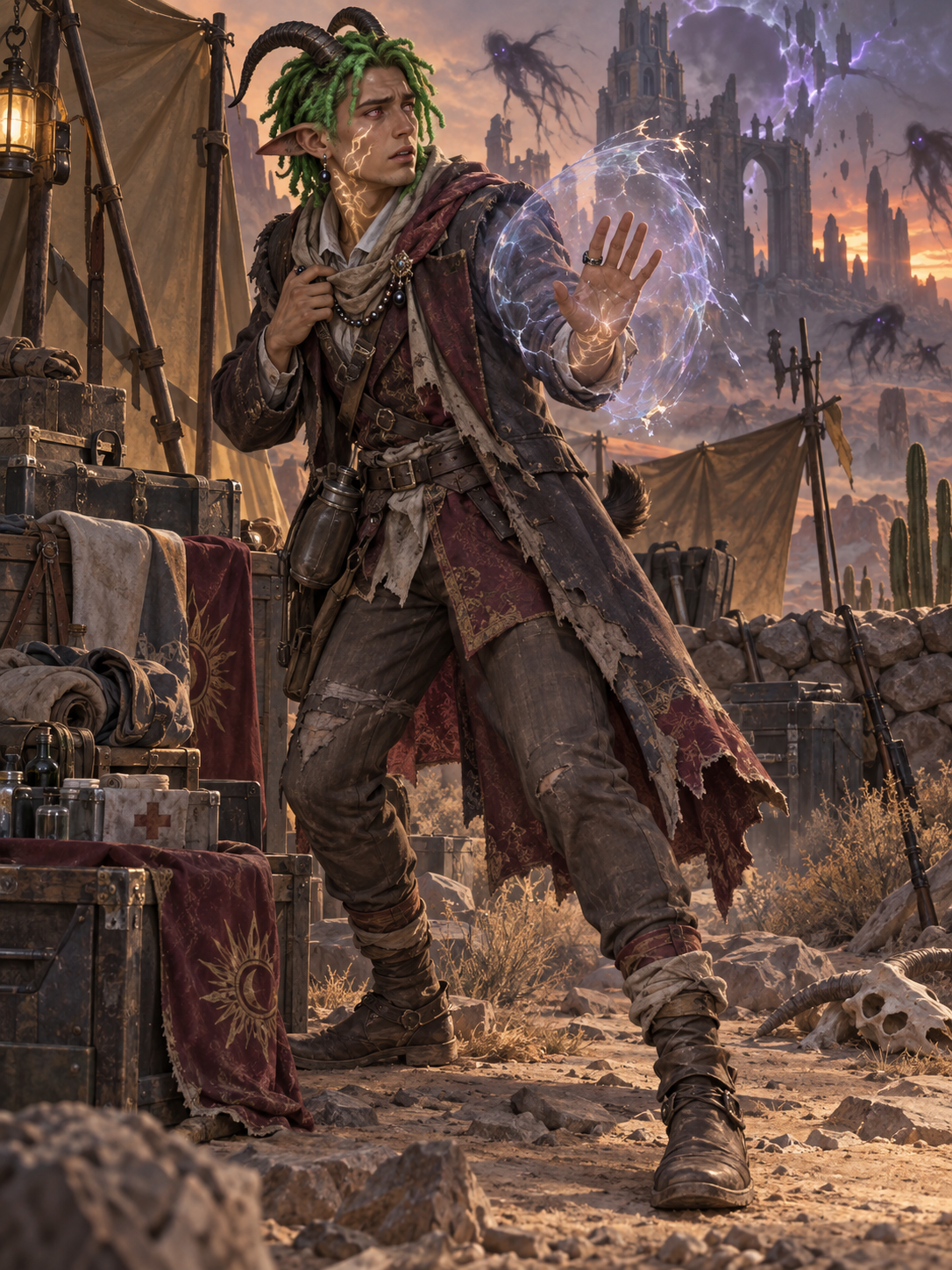 Nervous Tagalong
Chamois Demi-Human // Former Politician
Percival contributes knowledge of law, seals, restricted sites, political contacts, and upper-class behavior. He has not earned the crew's trust or completed any redemption.